Do Crystals Reduce Anxiety? The Short Answer
In the controlled studies available, the crystals tested did not reduce anxiety beyond a placebo. In a 2025 trial of 138 adults, rose quartz did no better than a look-alike fake stone; anxiety fell only among people who already believed in crystals, whichever stone they held. For anxiety itself, therapy, medication and meditation programs have much stronger evidence.
Anxiety is common. In the National Comorbidity Survey Replication, conducted in 2001–2003, an estimated 19.1% of U.S. adults had an anxiety disorder in the 12 months before they were surveyed, according to the National Institute of Mental Health (NIMH), and an estimated 31.1% experience one at some point in their lives. Treatments such as cognitive behavioral therapy (CBT) and medication help many people, and some also look for calming practices to use alongside them. Crystals are one of the things people ask about.
This post looks at the research, explains what the crystal offering at Shanti Dhara in Palo Alto is (the menu describes a hands-on session where you make your own crystal jewelry), and helps you decide whether it's worth trying.
What the Research Actually Says About Crystal Healing
Research on crystal healing is thin, and only a handful of controlled experiments exist. A few of them provide useful data points.
The most often cited is psychologist Christopher French's experiment at Goldsmiths, University of London, presented at a conference in 2001 rather than published as a peer-reviewed trial, as reported by Live Science. Eighty participants meditated for five minutes while holding either a real quartz crystal or a fake one they believed was real. Both groups reported similar sensations, such as warmth in the hand. The fake crystals produced the same reports as the real ones, and participants who believed in crystal healing were more likely to report effects, whichever stone they held.
A more recent study, published in CNS Spectrums (2025), tested 138 adults using rose quartz versus a visually matched placebo over 14 days. The researchers found no anxiety reduction attributable to the crystal itself. Anxiety fell only among participants classified as "believers" in crystal efficacy, and it fell in both the rose quartz and placebo groups; nonbelievers showed no reliable improvement.
What does this tell us? In these studies, the quartz and rose quartz tested showed no effect beyond placebo, and what changed people's reports was expectation. The CNS Spectrums authors concluded that the findings do not support attributing therapeutic value to crystals. Other stones haven't been tested in controlled research that we found, so there is no evidence either way for them specifically.
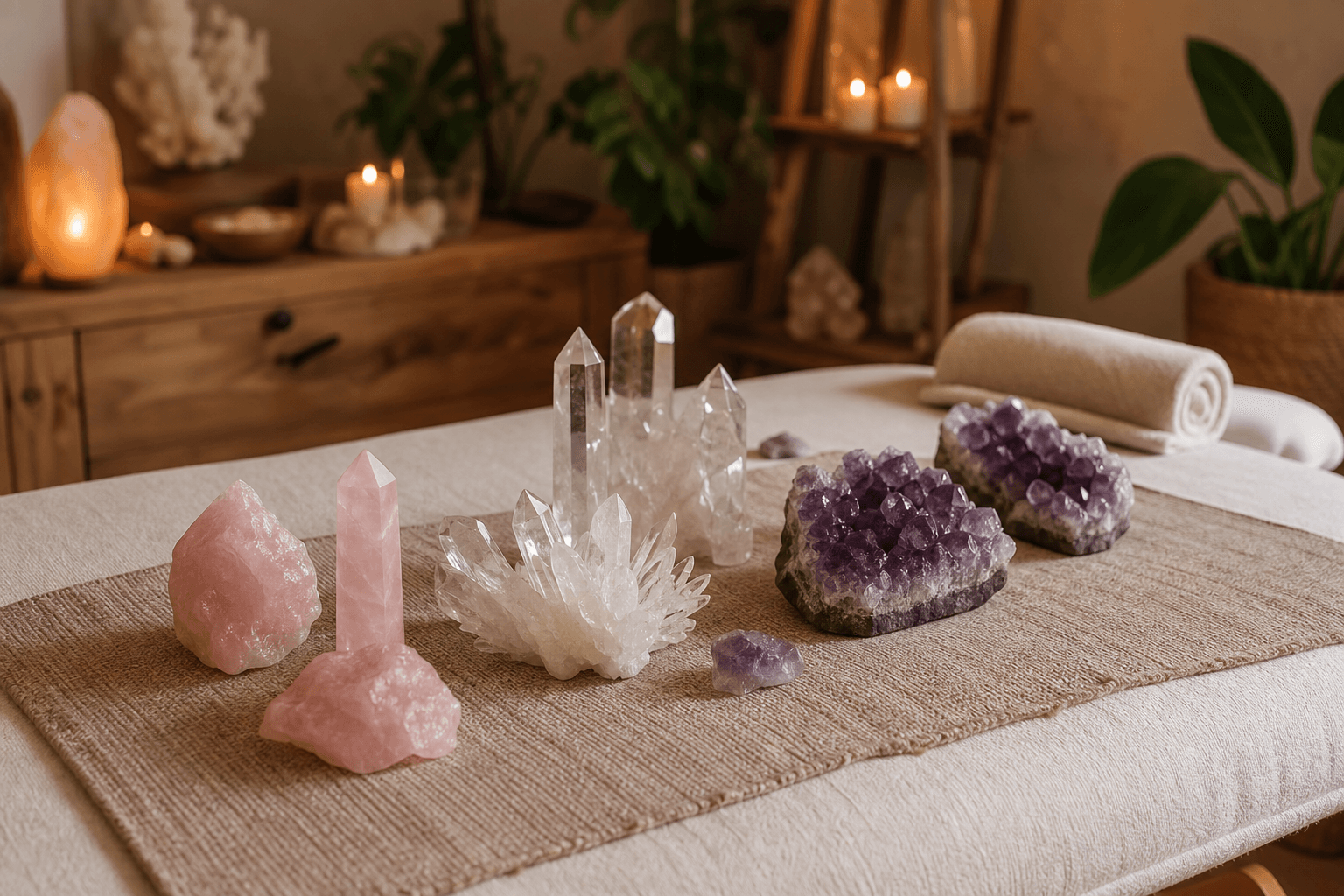
Illustration: rose quartz, amethyst and clear quartz, three stones associated with calm in crystal traditions.
What Placebo Research Does and Doesn't Show
Most people hear "placebo" and think "fake." Placebo research is more interesting than that: it shows that expectation and the context of a treatment can change how people report feeling, even when the pill or object has no active ingredient.
Ted Kaptchuk, a placebo researcher at Harvard Medical School, led a 2010 randomized trial in PLoS One in which 80 people with irritable bowel syndrome took pills openly labeled as placebo. Over three weeks they reported more symptom improvement than a no-pill group that got the same attention from providers. The authors concluded that placebos given without deception may be an effective treatment for IBS and called for further research; the trial measured reported symptoms, not a mechanism.
That is a narrow finding about reported symptoms in one condition. It doesn't show that crystal practices work through the same route, and it doesn't turn crystals into a treatment for anxiety. What the crystal studies do suggest is that any calm people feel while holding a stone seems to come from their expectations, not from the stone.
What Happens During a Crystal SoulCraft Session
Shanti Dhara Wellness calls its crystal offering the Crystal SoulCraft Experience. On the menu it's listed as Experience Crystal Energy: a 30-minute, hands-on session where you handpick crystals and make your own one-of-a-kind "energy jewelry," which the menu describes as designed to align with your personal energy. It's $38 for non-members and free for members, with up to 4 participants per session.
The studio's own description uses energy and healing language drawn from crystal traditions; the research above doesn't support those as effects on anxiety. What the menu documents is a creative, hands-on activity:
- Choosing your stones: You look at, handle and pick the crystals that appeal to you.
- Making something with your hands: You design your own piece of jewelry.
- Something to keep: You leave with a piece you made.
- A small group option: Up to 4 people can join one session, so it can work for friends, a couple, or a small family outing.
If you have questions about how the session runs, call the studio before booking. If you want to read more about what crystal healing claims and how to buy stones responsibly, our crystal energy guide covers it in more detail.

Illustration of a crystal layout of the kind some crystal-healing practitioners use. Shanti Dhara's Crystal SoulCraft session is listed on the menu as jewelry-making.
Which Crystals Are Associated With Calm, and Why
If you've looked into crystal healing, you've probably seen lists of "the best crystals for anxiety." Here are stones commonly associated with calm in crystal traditions, with the traditional associations only. These are beliefs, not medical claims or measured effects:
- Amethyst: A purple variety of quartz, traditionally associated with calm and mental clarity, and placed at the forehead or crown in crystal practice.
- Rose quartz: A pink quartz linked in crystal traditions to emotional healing and self-compassion, and traditionally placed at the heart center. It is the stone tested in the 2025 study above.
- Black tourmaline: Described in crystal traditions as a "grounding" stone believed to absorb scattered energy, and traditionally placed near the feet or the base of the spine.
- Lepidolite: A lilac mica that crystal traditions associate with transitions and emotional balance.
- Blue lace agate: A pale blue banded stone that crystal traditions link to the throat chakra and to self-expression. Whether you like its color and feel is a matter of taste.
- Clear quartz: Called the "master healer" in crystal traditions and said to amplify other stones. It is the stone type used in the French experiment above.
Only quartz and rose quartz appear in the controlled research above, and neither showed an effect beyond placebo; the others haven't been tested in that way. Treat the list as tradition and personal taste. If one of them appeals to you, it's the kind of stone you might pick for a piece of jewelry in the Crystal SoulCraft session. If you'd rather have a quiet session with more structure, Shanti Dhara's Chakra Therapy (75 minutes, $198, one guest) includes meditation, singing bowl therapy and Veda-Tea.
Who Might Enjoy a Crystal Session
The research doesn't identify anyone who gets an anxiety benefit from the stones themselves. People choose a crystal activity for other reasons, and these are preferences, not measured benefits:
People who like making things. The Crystal SoulCraft session is a craft activity; if choosing materials and making a small object appeals to you, that alone can be a reason to go.
Skeptics who are curious. The research suggests skeptics shouldn't expect an anxiety benefit from the stones. A skeptic can still enjoy choosing stones for their color and feel and making a piece of jewelry, without believing in a mechanism.
People who want a booked reason to pause. Some people find it easier to take a break when it's on the calendar. Whether that helps you is personal.
Anyone with an anxiety disorder. Crystal activities are not a medical treatment. If you're experiencing panic attacks, persistent worry that interferes with daily life, or other symptoms of an anxiety disorder, see a doctor or licensed mental health professional; a craft session can be something you enjoy alongside care, not a replacement for it.
What Has Stronger Evidence for Anxiety?
If anxiety is your main reason for looking into crystals, it helps to know which options have better research behind them. A 2014 systematic review and meta-analysis in JAMA Internal Medicine pooled 47 randomized trials with 3,515 participants and found moderate evidence that mindfulness meditation programs improved anxiety, with small to moderate effects at 8 weeks. The same review found no evidence that meditation was better than active treatments such as medication, exercise, or other behavioral therapies.
For generalized anxiety disorder, the NIMH says treatment typically involves psychotherapy, medication, or both, and that CBT is a research-supported type of psychotherapy commonly used for it. If your anxiety interferes with work, sleep, or relationships, start with your doctor or a licensed mental health professional.
Crystal work can sit alongside that as something you enjoy, as long as you don't expect the stone to do the work. In the studies above, the calm people reported tracked their expectations, not the stone.
FAQ: Crystal Healing and Anxiety
Do I need to believe in crystals to enjoy the session?
For the Crystal SoulCraft jewelry session, no. It's listed as a hands-on activity, and you can enjoy choosing stones and making something without any belief in crystal energy. For anxiety relief, the research is less encouraging: in the 2025 rose quartz study, anxiety fell only among believers, whether they held rose quartz or a fake, and nonbelievers showed no reliable improvement.
What if I don't feel anything during the session?
That's consistent with the research: in the controlled experiments, real and fake crystals produced the same reports. If you enjoyed choosing stones and making something, that's a perfectly good reason to come back; if you were hoping for relief from anxiety, talk to your doctor about options with stronger evidence.
Can crystal healing replace therapy or medication for anxiety?
No. If you're dealing with an anxiety disorder, panic disorder or PTSD, you need proper mental health care. A crystal activity can be something you enjoy alongside therapy and medication, but it's not a replacement.
How do I book a session at Shanti Dhara Wellness?
Shanti Dhara Wellness is at 2875 Middlefield Rd, Suite 8 (2nd floor), Palo Alto. Hours: Tuesday and Sunday 10 AM-4:30 PM, Wednesday-Saturday 10:30 AM-6 PM; closed Monday. Experience Crystal Energy is $38 for 30 minutes (free for members), for up to 4 people. Book through the online menu or call (650) 283-9121.
What should I wear to the crystal jewelry session?
Comfortable everyday clothes are a sensible choice for a hands-on craft activity. If you have questions about the session, call the studio before you go.