What Chakra Meditation Actually Is
Chakra meditation is a practice that moves your attention and breath, one region at a time, through a set of points along the body that yogic and tantric traditions call chakras, or energy centers. The word "chakra" comes from Sanskrit and means "wheel." In those traditions, chakras are described as centers running along the spine, from its base to the crown of the head. They are a belief system and a meditation map, not structures found in anatomy.
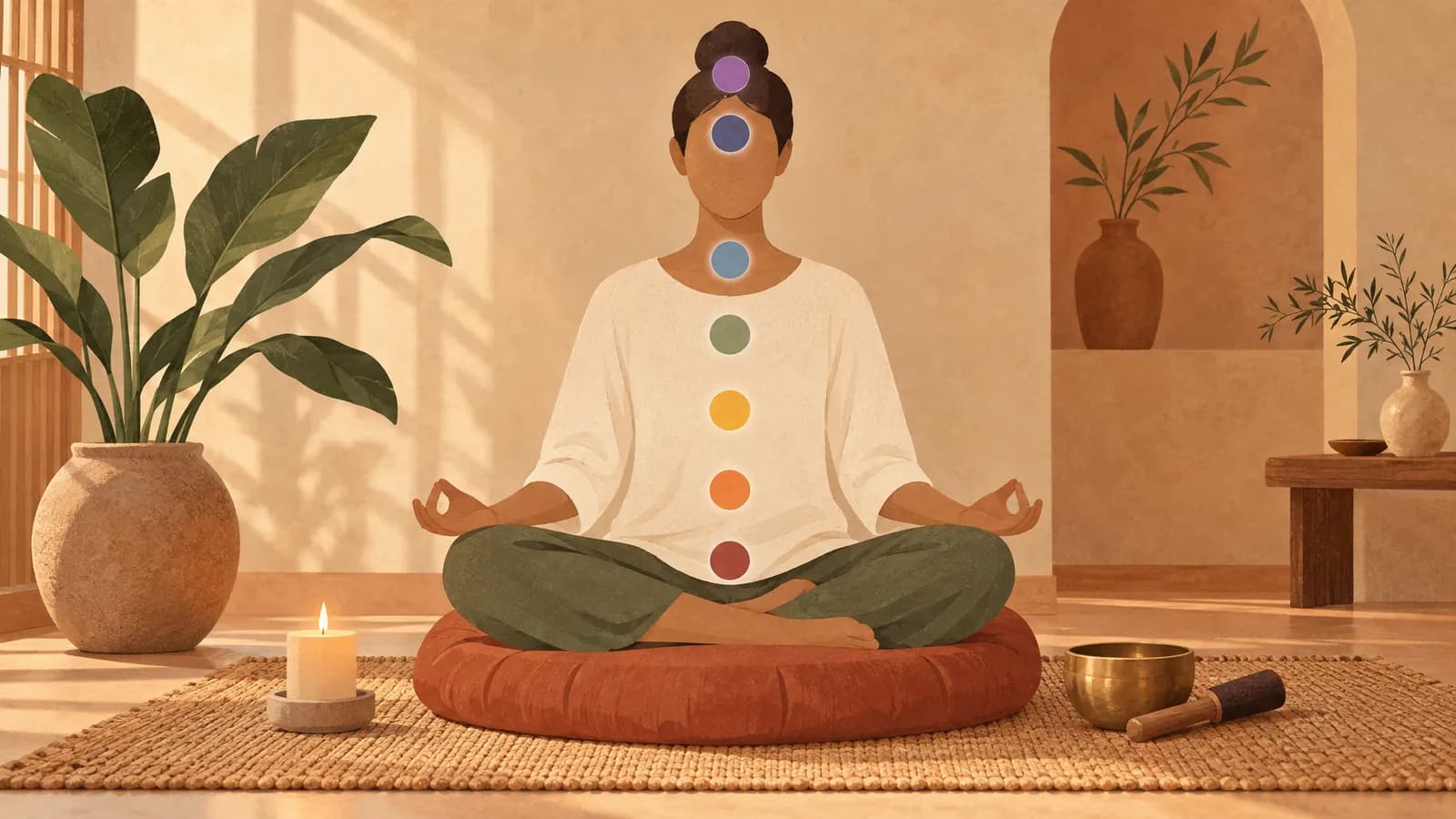
The practice itself is simple in structure even if the concept feels abstract at first. You sit or lie in a quiet space, focus your breath, and bring attention to each chakra in sequence, often visualizing its associated color or repeating a seed sound (called a bija mantra) tied to that center. A sequence can cover all seven in one sitting, or you can spend a sitting on just one center.
People turn to chakra meditation for a mix of reasons: chronic stress that won't ease with regular relaxation, a nagging sense of emotional imbalance, sleep trouble, or simply curiosity about a practice they've seen mentioned alongside yoga and sound healing. The idea has medieval roots: hierarchies of inner energy centers appear in Buddhist tantric texts from around the 8th century CE, and later Hindu tantric texts describe their own, differing systems. Today chakra meditation also shows up in secular wellness spaces as a relaxation practice, alongside practices like sound bath therapy and guided breathwork.
Where chakra meditation differs from general mindfulness meditation is its structure. Instead of open awareness or a single point of focus like the breath, you move through a mapped sequence of body regions, each with its own traditional associations. For some beginners that structure is the appeal: you always know where to put your attention next.
The Seven Chakras, Explained
The seven-chakra map most people meet today is a modern one. It draws on a system from Hindu tantric sources that Sir John Woodroffe translated into English in the early 20th century in The Serpent Power; the familiar rainbow colors and the list of psychological qualities were layered onto it by Western writers later in the 20th century. So read the list below as that modern, symbolic map as it is commonly taught in wellness settings, not as a description of how your body or mind works, and not as a way to diagnose anything:
- Root (Muladhara) — Base of the spine. Commonly associated with safety and stability, and with the color red.
- Sacral (Svadhisthana) — Lower abdomen, below the navel. Commonly associated with creativity and pleasure, and with orange.
- Solar Plexus (Manipura) — Upper abdomen. Commonly associated with confidence and willpower, and with yellow.
- Heart (Anahata) — Center of the chest. Commonly associated with love and compassion, and with green.
- Throat (Vishuddha) — Throat area. Commonly associated with communication and self-expression, and with blue.
- Third Eye (Ajna) — Between the eyebrows. Commonly associated with intuition, and with indigo. Shanti Dhara's menu describes the oil in Shirodhara as flowing onto the Ajna Chakra (third eye).
- Crown (Sahasrara) — Top of the head. Commonly associated with spiritual connection, and with violet or white.
Some teachers talk about a chakra being "blocked." That is language from the belief system, not a diagnosis, and a symptom such as anxiety, a tight throat or low mood deserves a real assessment from a clinician rather than a chakra reading. Used as a meditation map, the list simply gives you seven places to rest your attention in order, whatever you think about the energy theory behind it.
Crystals are a common visual anchor for chakra meditation, though the practice itself relies on breath and attention.
How to Practice Chakra Meditation at Home
You don't need special equipment to start. Here's a simple sequence you can try in 15 to 20 minutes:
- Find a quiet spot and sit or lie down comfortably. Close your eyes and take five slow breaths to settle in.
- Start at the root chakra. Bring your attention to the base of your spine. Visualize a red light or simply notice the sensation of your body against the floor or chair. Breathe here for 1-2 minutes.
- Move upward one chakra at a time. Spend roughly the same amount of time on each: sacral, solar plexus, heart, throat, third eye, and crown. Notice which areas feel easy to sense and which feel harder to locate. That difficulty is useful information, not a failure.
- Use a mantra if it helps. Each chakra has a traditional seed sound (root: "LAM," sacral: "VAM," solar plexus: "RAM," heart: "YAM," throat: "HAM," third eye: "OM," the crown traditionally has no seed sound, so you can simply rest in silence there). Repeating these softly, even mentally, can help hold your focus in place.
- Close by returning to full-body awareness. Take a few deep breaths, wiggle your fingers and toes, and open your eyes slowly.
How long and how often you practice is up to you; a short session you actually do is more useful than a long one you keep putting off. If you're new to this, don't worry about "feeling" energy in a dramatic way. Noticing where your attention wanders, or where your body feels tense, is a legitimate place to start.
Some people find self-guided practice frustrating because it's hard to know if you're doing it "right." That's one reason some people try a session in a studio, and some simply prefer having live sound to focus on instead of pure visualization. That is a matter of taste rather than a proven advantage.
Chakra Therapy at Shanti Dhara: What the Menu Lists
If you'd rather not practice alone, a studio session is another route. At Shanti Dhara Wellness in Palo Alto, the Chakra Therapy session (75 minutes, $198) is listed on the menu as a one-guest session at 2:00 PM that includes three things: meditation, singing bowl therapy, and Veda-Tea.
The menu does not spell out the order or format of those parts, so if you want to know how the 75 minutes run, whether the meditation follows the seven-chakra sequence above, or how much of the session is sound, ask the studio when you book. It is also the time to mention anything that affects your comfort, such as sensitivity to loud sounds.
Whatever the format, give yourself a few unhurried minutes before you drive away; getting up slowly after lying still for a while is simply sensible.
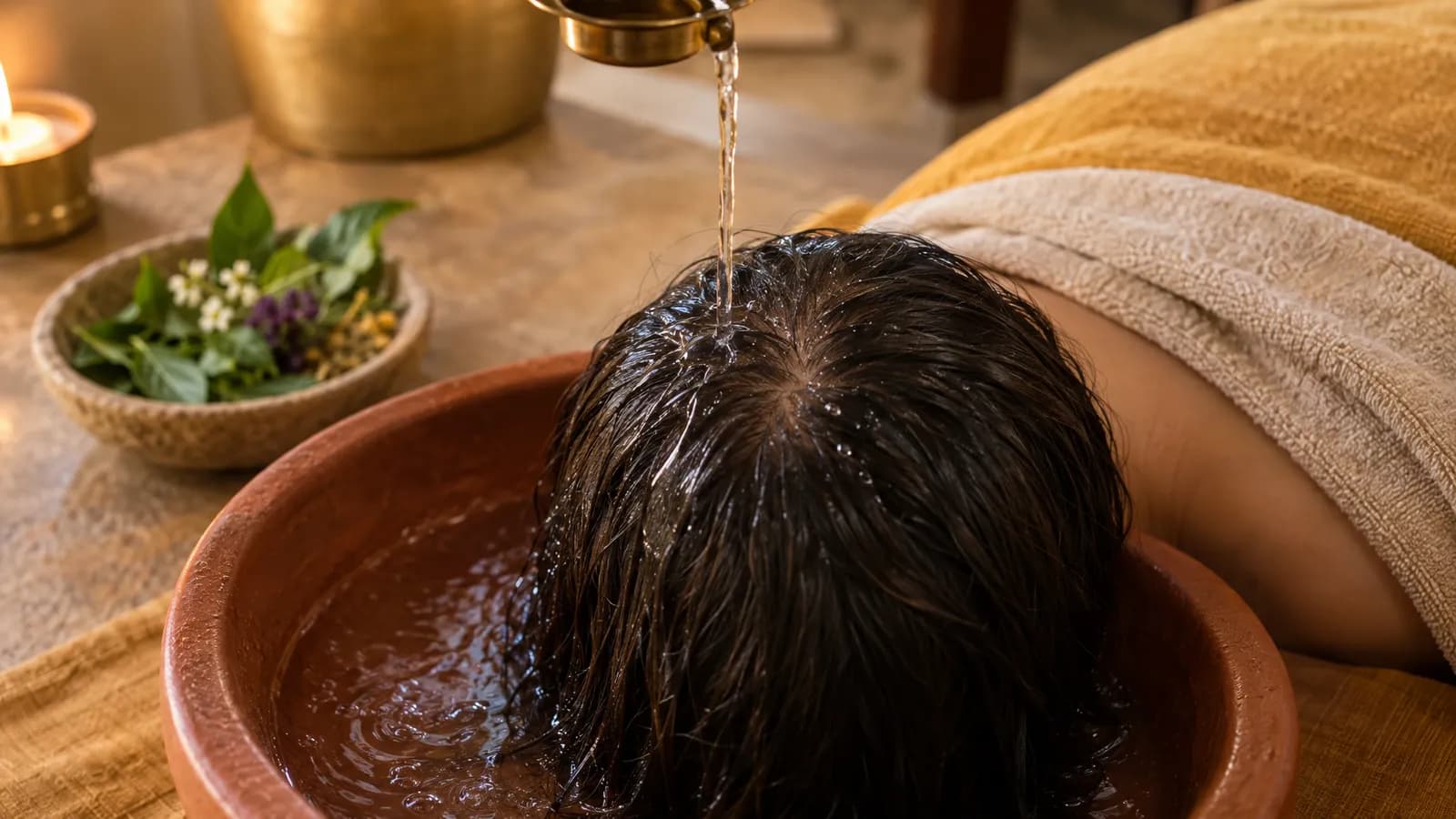
For guests who want a flowing-liquid treatment, the Ethereal Chakra Drip (75 minutes, $268) is worth considering as a next step. A flow of citrus-and-floral botanical essence cascades across the scalp, aimed at the crown chakra, rather than moving through all seven centers. It's a water ritual, not an oil pour; if warm oil is what you're after, Sacred Shirodhara Therapy is the oil-stream treatment. The practical difference is sensory: Chakra Therapy is meditation, singing bowls and tea, while the Chakra Drip is a scalp treatment.
What the Research Says About Meditation and Sound Therapy
Chakra theory itself is a traditional framework rather than a measurable physiological system, and research on chakra meditation specifically is limited. It does exist: for example, a small 2024 study in the International Journal for Multidisciplinary Research (Verma and Verma) compared an experimental and a control group, 20 working women in total, and reported lower anxiety scores on the Hamilton Anxiety Rating Scale after chakra meditation. One study of 20 people cannot show that chakra meditation reliably reduces anxiety, and it did not test Shanti Dhara's Chakra Therapy session.
Some of the ingredients chakra meditation uses, meditation, slow breathing and singing bowls, have been studied on their own. The studies below did not test chakra meditation or Shanti Dhara's session, so read them as background, not as evidence that this particular practice or treatment works.
A widely cited 2014 meta-analysis in JAMA Internal Medicine (Goyal et al.) reviewed 47 trials with 3,515 participants and found that mindfulness meditation programs produced small to moderate improvements in anxiety, depression and pain; the same review found no evidence that meditation beat active treatments such as drugs or exercise. Separately, a small 2023 EEG study of 17 young adults found that brainwave activity rose at a singing bowl's beat frequency, which sits in the theta range associated with relaxed meditation, and a 2017 observational study of 62 adults reported significantly less tension, anger, fatigue and depressed mood after a singing bowl meditation. That last study had no control group, so it shows what people reported afterward, not proof that the bowls caused it.
Slow breathing, which many meditation sequences include, has also been studied separately. Slow breathing is thought to engage the parasympathetic "rest and digest" side of the nervous system, and that is measurable: a 2022 meta-analysis of 223 studies (Laborde et al., Neuroscience & Biobehavioral Reviews) found that voluntary slow breathing raised vagally mediated heart rate variability during practice, right after a single session, and after multi-session programs.
None of this proves that a "root chakra" exists, and none of it shows that a chakra-based session does more than any other quiet, structured relaxation. What it does suggest is that meditation and slow breathing are reasonable things to try for everyday stress, and chakra meditation is one of many ways to structure them. You don't have to accept the energy model to try it as a relaxation exercise.
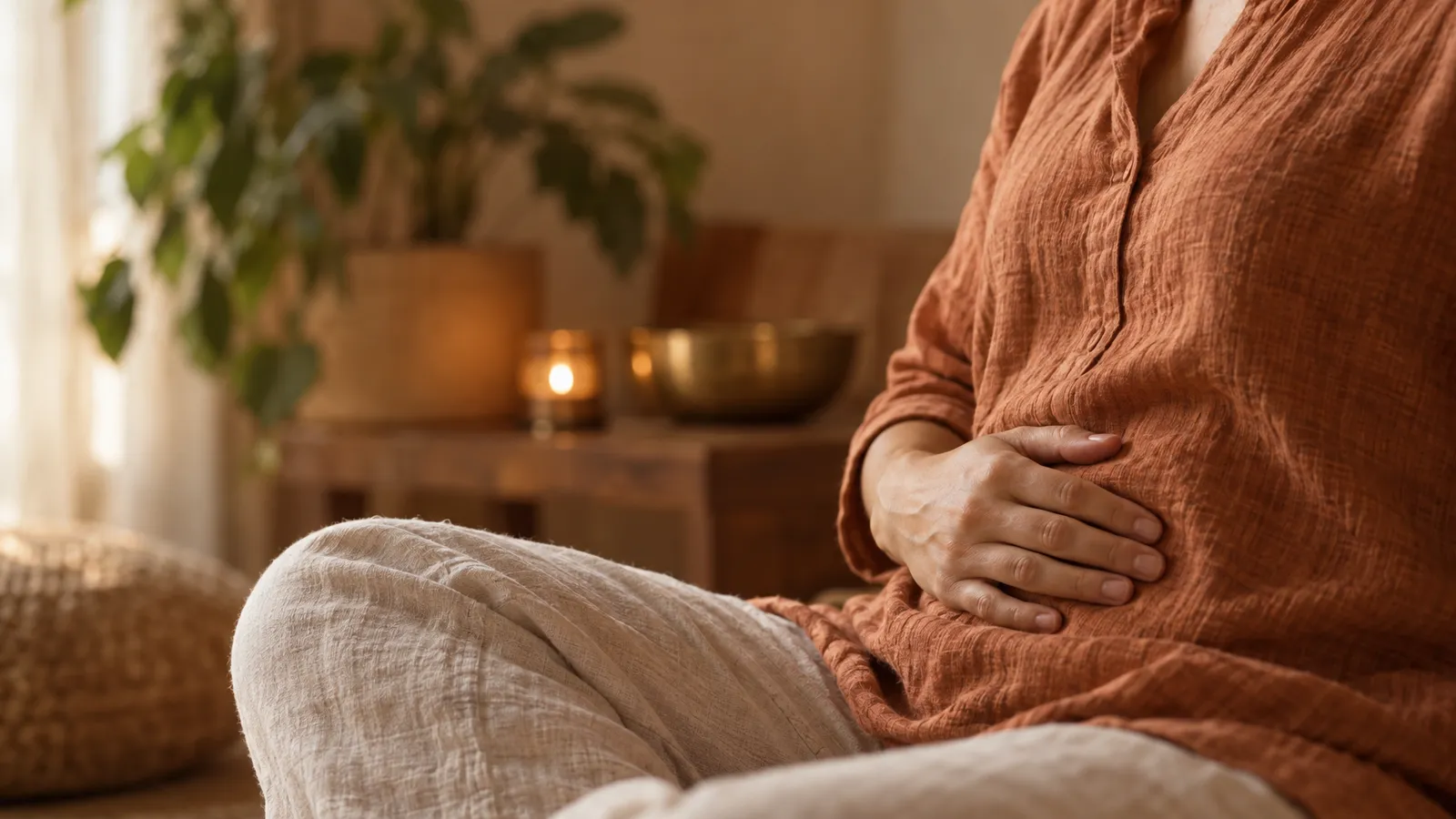
Singing bowl therapy gives you a sustained tone to focus on.
Who Should Try Chakra Meditation (and Who Should Start Elsewhere)
The studies discussed here do not establish who benefits most from chakra meditation, so the suggestions below are about preference. It may appeal if you want a relaxation practice for everyday stress, or if you've tried open-awareness meditation and wanted more structure; seven defined checkpoints give your attention somewhere concrete to land.
If you're dealing with an acute physical injury, a diagnosed mental health condition, or severe anxiety that makes sitting still for 20 minutes genuinely distressing, start with your doctor or clinician: chakra meditation is not a treatment for any of these. If, alongside that care, you simply want something relaxing and sitting with your own attention feels like too much, a hands-on treatment such as a full-body Abhyanga massage may feel easier, because you receive the treatment rather than having to self-direct your attention.
A Chakra Therapy session may appeal to:
- Those who've tried meditation apps but stopped because sessions felt repetitive or hard to stick with alone.
- Anyone curious about chakra meditation who would rather try it in a studio session than work from a written sequence (ask the studio how the meditation part is run).
- People who like sound as a focus. The session includes singing bowl therapy.
- Guests who already enjoy Ayurvedic bodywork and want to try something without massage.
If you're not sure which option fits, call Shanti Dhara at (650) 283-9121 and describe what's bringing you in; Chakra Therapy runs as a 75-minute, one-guest session at 2:00 PM, and the full list of treatments is on the menu.
FAQ: Chakra Meditation and Chakra Therapy
How long does it take to see results from chakra meditation?
Evidence on chakra meditation specifically is limited: the small studies discussed on this page do not establish how quickly, or whether, it works. The trials in the 2014 JAMA review studied meditation programs practiced over weeks, not single sessions, so if you are hoping for lasting change, think in terms of regular practice rather than one visit.
Do I need to believe in energy healing for chakra meditation to work?
No. You can approach it purely as a structured relaxation exercise built on attention and breathing. The research on meditation and slow breathing in general summarized above did not test chakra meditation, and none of it depends on believing in the energy framework.
What's the difference between Chakra Therapy and a regular meditation class?
A regular meditation class typically focuses on breath or open awareness without a specific bodily map. Chakra Therapy at Shanti Dhara (75 minutes, $198) is a one-guest session that the menu lists as including meditation, singing bowl therapy and Veda-Tea, so it adds live sound and tea to the meditation. Ask the studio when you book how the meditation is run.
Can chakra meditation help with anxiety?
The evidence is thin. One small 2024 study of 20 working women reported lower anxiety scores after chakra meditation, but a single study that size can't establish that it works, and it didn't test this studio's session. Mindfulness meditation programs showed small to moderate improvements in anxiety in the 2014 JAMA review, and whether you prefer a studio session with sound or silent practice is personal. It's not a replacement for treatment of a diagnosed anxiety disorder, but it can sit alongside that treatment as a complementary practice.
How often should I book a Chakra Therapy session?
There's no fixed rule. A reasonable approach is to try one session, see how you feel over the following days, and space the next one accordingly.