
The Short Answer: Ask Your Pregnancy Provider First
Whether an Ayurvedic massage is right for you during pregnancy is a question for your pregnancy provider before it is one for any spa. General guidance on prenatal massage exists, but it is about massage in general, not about warm herbal oils, herbal poultices or oil pooled over the lower back. Start with your provider, then ask the studio specific questions about the treatment you want.
This is a common question from people who enjoyed Abhyanga before pregnancy and want to know whether they can keep going. This article isn't medical advice. It sets out what published medical guidance says about prenatal massage, what it doesn't cover, and what to ask before you book, at Shanti Dhara Wellness or anywhere else.
What Medical Guidance Says About Prenatal Massage
Cleveland Clinic's article on prenatal massage is a useful starting point (Cleveland Clinic). The main points:
- Timing. "Most pregnancy providers usually recommend waiting until the beginning of the second trimester (12 weeks pregnant and beyond)."
- Position. Prenatal massages "are typically done while you lie on your side," with supportive pillows or bolsters. Cleveland Clinic says lying on your back or stomach raises the risk of low blood pressure and could put pressure on your nerves.
- Pressure. A prenatal massage "is generally going to use very light pressure — no more than firm to medium pressure," and deep tissue work is avoided.
- Length. "Prenatal massages generally last anywhere from 15 minutes to an hour."
- Who should check first. Everyone, and especially people with "pregnancy concerns like gestational diabetes, high blood pressure and other conditions."
- Who to see. "Choose a reputable massage therapist who's trained to provide prenatal massage."
The same article lists possible benefits of prenatal massage, including reduced stress and eased back and leg pain. Those are general findings about prenatal massage, not results of any particular Ayurvedic treatment.
Why the First Trimester Is Treated Differently
Cleveland Clinic's miscarriage guidance says "most miscarriages happen in the first trimester of pregnancy," and that "the risk of pregnancy loss in the first trimester is about 1 in 10. In the second trimester, the risk is lower — around 1 in 100" (Cleveland Clinic). That is the background to the common advice to wait until the second trimester for massage.
The same page is clear about what does not cause miscarriage: "There isn't any scientific proof that stress, exercise, sex or birth control pills cause miscarriage." Waiting is a cautious choice many providers recommend, not evidence that massage is harmful. If you are in your first trimester, the simplest course is to follow your provider's advice on timing.
Photo: Dang Ngoc Kha / Unsplash.
What the Guidance Doesn't Cover: Ayurvedic Treatments
The prenatal-massage guidance above is about ordinary massage technique: position, pressure and length. It does not address the things that make Ayurvedic treatments different. Here is how Shanti Dhara's menu describes its body and head treatments, and the questions each one raises for a pregnant client:
- Abhyanga Body Treatment (75 minutes $228, 90 minutes $268): "a flowing warm herbal oil massage." Ask which oils and herbs are used, how warm the oil is, how you would be positioned, and whether the session can be shorter than 75 minutes, since Cleveland Clinic's range for prenatal massage is 15 minutes to an hour.
- Abhyanga + Kati-Vasti (75 minutes $258, 90 minutes $298): combines Abhyanga with Kati Vasti, "where warm herbal oil pools over the lumbar area." Ask how you would be positioned for the lower-back part, and what heat is involved.
- Abhyanga + Podikizhi (75 minutes $258, 90 minutes $298): "warm herbal bundles are gently pressed across the body." Ask which herbs are in the bundles and how warm they are.
- Sacred Shirodhara Therapy (75 minutes $288, 90 minutes $328): combines herbal oils with Shirodhara warm oil therapy, using "gently heated oil." Ask how you would be positioned during the treatment and for how long.
None of the medical sources used here gives a pregnancy-specific rule for these treatments, and this article doesn't invent one. Bring the menu description to your pregnancy provider, ask about the herbs, oils and heat involved, and let their answer guide what you book.
Warning Signs That Come Before Any Massage
Some symptoms are a reason to contact your provider, not to book a treatment:
- Bleeding or cramping. Cleveland Clinic lists vaginal bleeding, cramping or pain in the lower belly "stronger than a period," and low back pain among the symptoms of miscarriage.
- Signs of preeclampsia. Cleveland Clinic says preeclampsia "usually develops after the 20th week of pregnancy," and lists symptoms including headaches, "blurry vision or light sensitivity," and "swelling in your hands, ankles and face." It advises going to a hospital right away for symptoms such as "blurry vision" or a "severe headache that won't go away" (Cleveland Clinic).
- Any restriction from your provider. If your provider has told you to limit activity, ask them directly whether that includes massage and which kinds.
During any session, if a position feels wrong, pressure is uncomfortable or you feel light-headed, say so and stop. Cleveland Clinic's reason for side-lying positioning is the risk of low blood pressure when lying on your back or stomach.
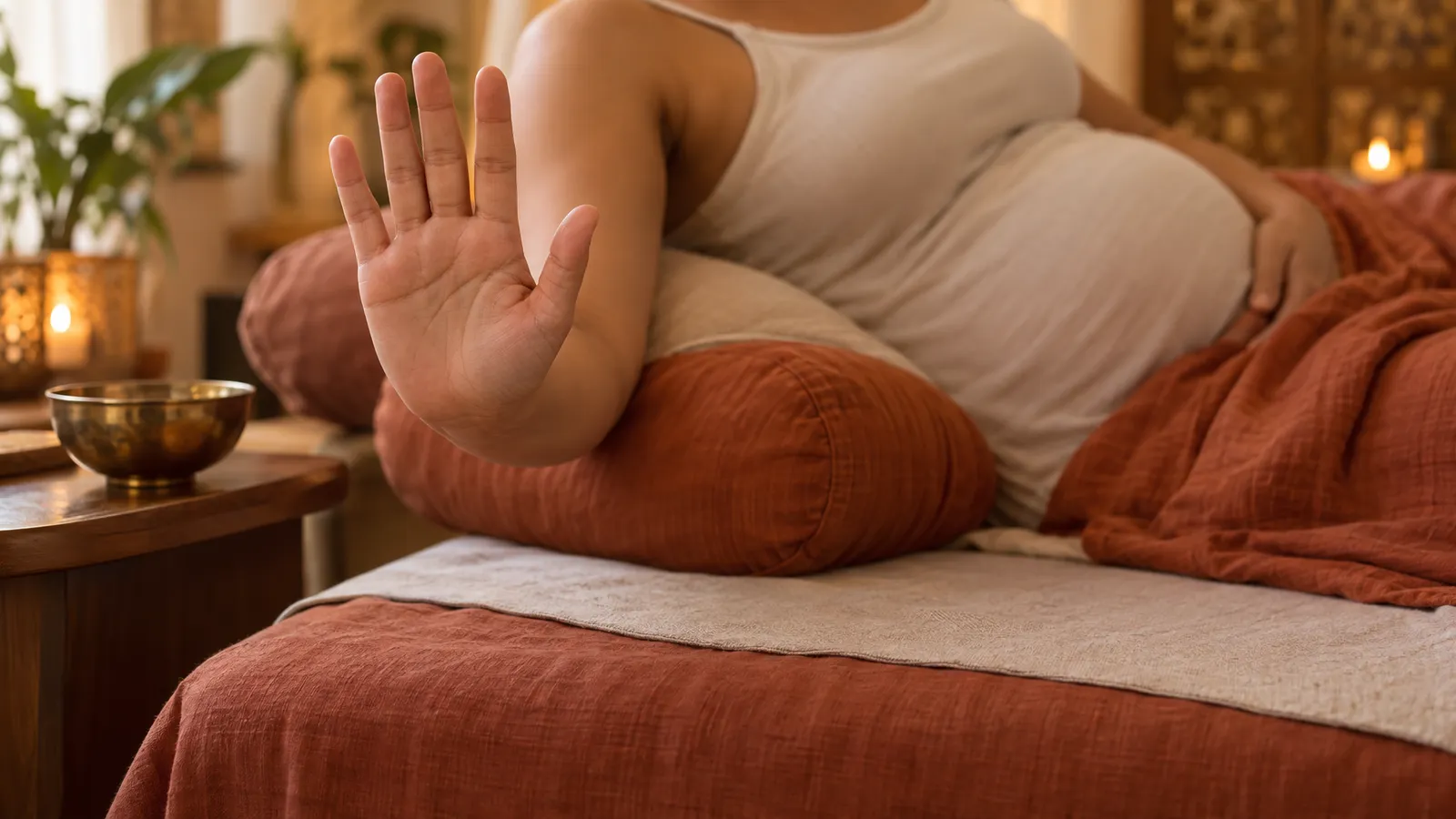
Photo: Alan Caishan / Unsplash.
Questions to Ask Before You Book
Whether you're calling Shanti Dhara or another wellness center, come with a short list:
- Has my pregnancy provider said massage is fine at my current stage? Ask them before you book, and again if anything changes.
- Does the studio accept pregnant clients for this treatment? Ask directly rather than assuming.
- Is the therapist trained in prenatal massage? That is Cleveland Clinic's advice for choosing a therapist. Ask about the person who would do your session and their credentials.
- How would I be positioned, and for how long? Cleveland Clinic describes side-lying with pillows or bolsters as typical for prenatal massage.
- What oils, herbs and heat are used? Ask for the ingredients so you can check them with your provider.
Shanti Dhara doesn't list a treatment designed for pregnancy on its menu, so call the studio at (650) 283-9121 before booking online and ask these questions. Talk with your pregnancy provider before that call, so you can bring their guidance with you.
Options Without Massage
If massage isn't right for you at the moment, the menu has sessions with no bodywork. Relax Therapy is 60 minutes of meditation, singing bowl therapy and Veda-Tea for $158. Ask what is in the tea and check it with your provider, as you would any herbal product during pregnancy. The menu also lists a 30-minute Nap Break ($98).
If you're planning ahead for after your pregnancy, our guide on how to prepare for your Ayurvedic massage covers general first-session guidance. Shanti Dhara Wellness is at 2875 Middlefield Rd, STE 8, 2nd floor, Palo Alto.
FAQ: Ayurvedic Massage and Pregnancy
Can I get an Ayurvedic massage in my first trimester?
Cleveland Clinic says most pregnancy providers recommend waiting until the beginning of the second trimester (12 weeks and beyond) for prenatal massage. Ask your own provider what applies to you.
Is Shirodhara safe during pregnancy?
The medical guidance used here doesn't address Shirodhara specifically. Shanti Dhara's Shirodhara appointments are 75 or 90 minutes. Ask the studio how you would be positioned and for how long, and check with your pregnancy provider before booking; Cleveland Clinic notes that lying on your back raises the risk of low blood pressure.
What about Kati Vasti for pregnancy-related back pain?
Back pain in pregnancy is worth raising with your pregnancy provider first. Kati Vasti pools warm herbal oil over the lower back; ask your provider about the heat and positioning involved, and ask the studio whether it accepts pregnant clients for it.
Do I need a doctor's note to book a prenatal massage?
Shanti Dhara's menu doesn't state a policy, so ask when you call. Either way, Cleveland Clinic advises checking with your pregnancy provider before a prenatal massage.
What if I'm not sure whether I'm high-risk?
Ask your pregnancy provider before booking any massage. Cleveland Clinic specifically mentions gestational diabetes and high blood pressure among the concerns to discuss first.