Group Sound Baths vs One-on-One Bowl Therapy
Sound baths and individual singing bowl therapy look similar but deliver very different results. Here's how to decide which one fits your goals.
Sound Baths and Singing Bowl Therapy: Not the Same Thing
If you've searched for "singing bowl therapy Bay Area" or "sound bath near me," you've probably noticed the two terms used interchangeably. Studios, spas, and wellness centers across the Peninsula list them as if they're the same experience. They're not. The confusion makes sense — both involve singing bowls, both promise relaxation, and both fall under the broader umbrella of sound healing. But the experience, the therapeutic intent, and the outcomes differ in ways that actually matter when you're deciding where to spend your money and time.
A sound bath is a group experience. You lie on a mat in a room with 10, 20, or sometimes 50+ other people while a facilitator plays a collection of instruments — crystal bowls, Tibetan bowls, gongs, chimes, and sometimes didgeridoos or tuning forks. The sound washes over the group. You're receiving the same frequencies as everyone else. It's passive, ambient, and communal.
Singing bowl therapy is a one-on-one clinical session. A trained practitioner places specific bowls on or near your body, targets particular chakras or tension points, and adjusts the frequency, placement, and duration based on what they observe in real time. You're the only person in the room. The session is personalized, responsive, and intentionally structured.
Think of it this way: a sound bath is to singing bowl therapy what a yoga class is to a private physical therapy session. Both can help. But one is designed for you specifically. At Shanti Dhara Wellness in Palo Alto, the Healing Bowl Therapy program is individual, not group — and that distinction shapes everything from the session structure to the results clients report.
How Sound Baths Work: The Group Experience
Sound baths became popular in the Bay Area around 2015-2016, riding the wave of mindfulness culture that swept through tech companies. Today, you can find them at yoga studios in Mountain View, community centers in San Jose, and outdoor events in Golden Gate Park. A typical session runs 45-75 minutes and costs $25-$45 per person.
Here's the format: participants arrive, lay out yoga mats or blankets on the floor, and settle into savasana (lying face-up with eyes closed). The facilitator sits at the front of the room surrounded by instruments. Once everyone is settled, they begin playing — starting softly with a single bowl and gradually layering in more instruments. The idea is "bathing" in sound, letting the vibrations fill the room and pass through your body without any targeted intervention.
The group dynamic is both the appeal and the limitation. On the positive side, the communal energy can feel powerful. Many regular sound bath attendees describe a sense of collective calm that's harder to access alone. The price point is accessible, and there's no preparation or consultation required. You just show up.
On the flip side, the facilitator can't tailor anything to you individually. If you're dealing with chronic anxiety that centers in your chest, the practitioner isn't going to place a bowl on your sternum and work that specific area. The room's acoustics scatter the vibrations — you're getting ambient sound, not directed frequency. And group sizes vary wildly. A 12-person sound bath in a small studio feels intimate. A 60-person event in a warehouse feels more like a concert. The therapeutic intensity scales inversely with group size.
Sound baths are a great entry point if you're curious about sound healing. They're affordable, low-commitment, and widely available. But they're more relaxation experience than therapeutic intervention. For a detailed comparison of group versus private sound healing formats, our comprehensive guide explores the nuances of each approach.
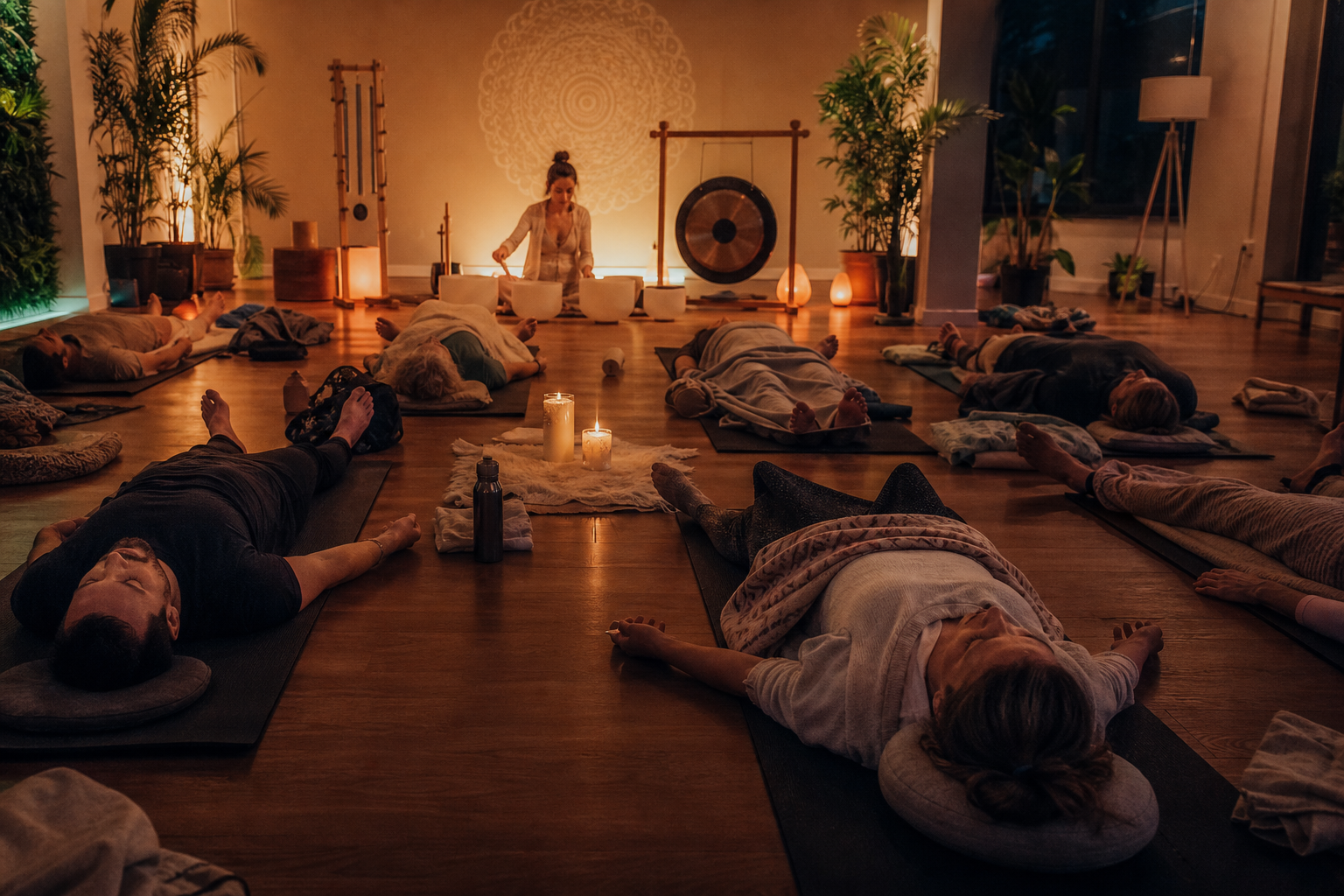
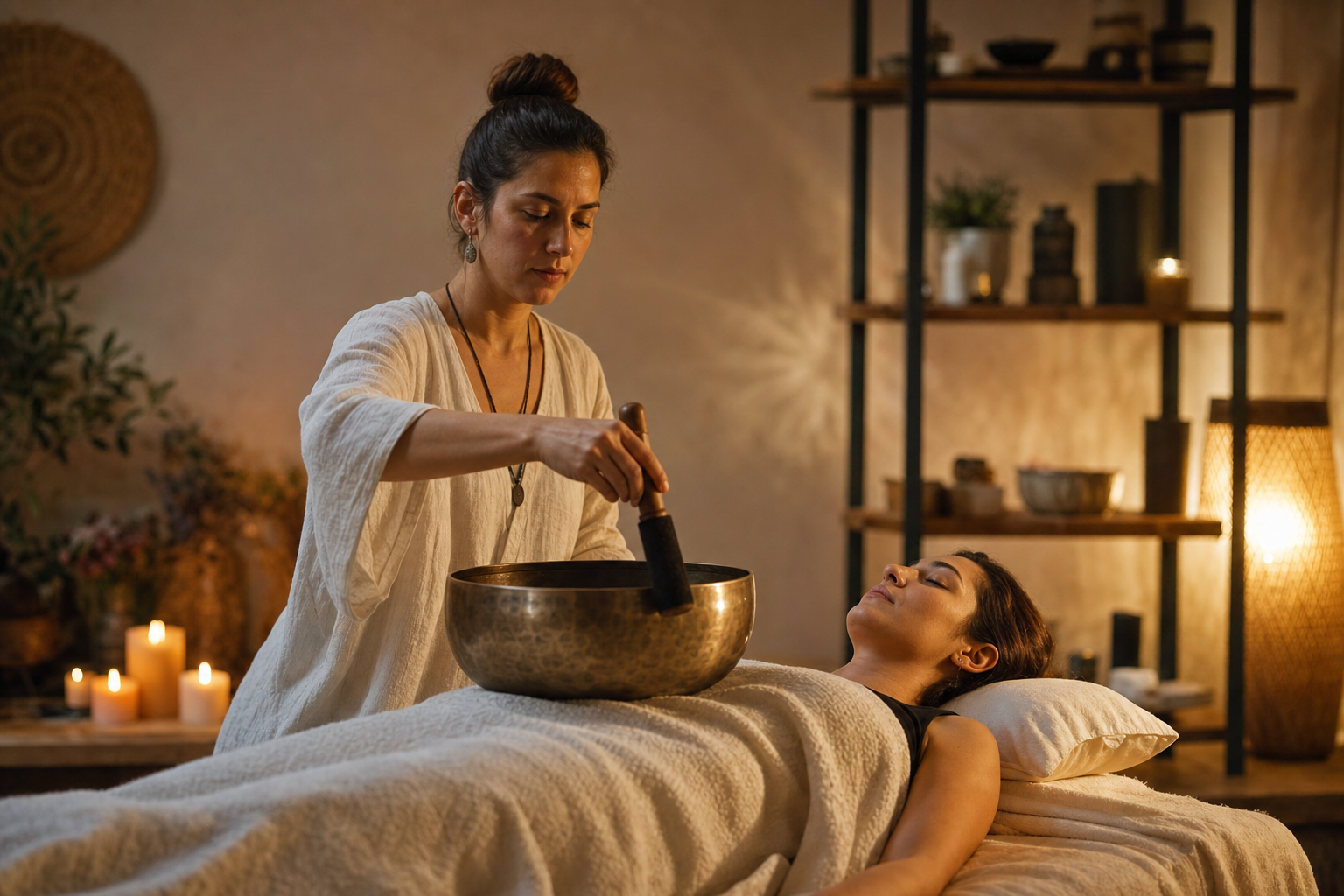
Individual singing bowl therapy targets specific areas of the body, unlike the ambient wash of a group sound bath.
How Singing Bowl Therapy Works: The Individual Session
Singing bowl therapy — sometimes called singing bowl healing or vibrational sound therapy — is a one-on-one treatment where a practitioner uses specific bowls placed directly on or very close to your body. The vibrations transfer through direct contact, not just ambient air. This is the critical mechanical difference: vibrations conducted through tissue behave differently than vibrations traveling through air across a room.
At Shanti Dhara Wellness, the Healing Bowl Therapy program offers three formats, each building in depth:
- Nap Break (30 minutes, 8:30 AM). A focused morning session for up to 3 guests. Think of it as a nervous system reset before your workday starts. The practitioner uses 2-3 bowls targeting the areas where you hold the most tension.
- Relax Therapy (60 minutes, 12:30 PM). A deeper midday session for up to 2 guests. It includes guided meditation, singing bowl placement along the body's energy centers, and a Veda-Tea ceremony to close. This is the most popular option for clients dealing with chronic stress or anxiety.
- Chakra Therapy (75 minutes, 2:00 PM). A fully private, one-on-one session. The practitioner maps all 7 major chakras and uses specific bowls tuned to corresponding frequencies. This format allows the deepest personalization — the practitioner can spend 10-15 minutes on a single energy center that needs attention, which is impossible in a group setting.
The key difference from a sound bath: your practitioner is observing you throughout the session. They notice where your body tenses, where your breathing shifts, and where the bowls produce more or less resonance. They adjust in real time. A skilled bowl therapist reads your body's response to each frequency the way a physical therapist reads your response to each stretch. The session becomes a conversation between your nervous system and the vibrations, not a one-way broadcast.
The Science Behind Sound Vibration Therapy (2026 Update)
Sound healing sits in an interesting scientific space — there's genuine biophysical mechanism at work, even though the research is still catching up. Here's what we know as of 2026:
Brainwave entrainment. When you're exposed to rhythmic auditory stimulation, your brainwaves tend to synchronize with the frequency of the sound. Singing bowls typically produce frequencies in the 100-900 Hz range, with overtones that can push your brain toward alpha (8-12 Hz) and theta (4-8 Hz) states. Alpha is associated with relaxed alertness; theta with deep meditation and the edge of sleep. A 2020 study in the Journal of Evidence-Based Integrative Medicine found that participants in a singing bowl session showed significant reductions in tension, anxiety, and depressed mood, with the strongest effects in people who hadn't meditated before. More recently, a 2026 study published in the Journal of Holistic Healthcare and Medicine confirmed that singing bowl therapy shows measurable neurophysiological impacts on stress reduction markers.
Vagal nerve stimulation. The vagus nerve, which runs from your brainstem through your chest and abdomen, plays a key role in your parasympathetic "rest and digest" response. Low-frequency vibrations — the kind produced by larger Tibetan bowls — appear to stimulate vagal tone. This isn't fringe theory; medical devices that stimulate the vagus nerve are FDA-approved for treating epilepsy and depression. Sound therapy is a gentler, less invasive version of the same mechanism.
Cellular resonance. Every cell in your body has a natural frequency. When you introduce sound waves at or near that frequency, cells can vibrate in sympathy. This is called resonance, and it's the same principle that lets a singer shatter a wine glass. Obviously, singing bowls don't shatter cells — the amplitude is too low — but there's emerging evidence that resonant frequencies can influence cellular behavior. A 2025 systematic review of clinical studies concluded that singing bowl therapy may help reduce anxiety and depression while improving sleep quality, though researchers note the mechanisms are still being mapped.
Cortisol reduction. Cortisol is your body's main stress hormone. Multiple studies on sound healing modalities have documented drops in salivary cortisol levels immediately following a session. A 2022 pilot study at the University of California, San Diego, measured cortisol before and after a 60-minute singing bowl session and found an average reduction of 18%. That's comparable to the cortisol drop you'd see after a moderate-intensity massage.
The nuance here: most of these studies look at group sound baths, not individual bowl therapy. Why? Because group sessions are easier to study — you can measure 30 people at once. The irony is that one-on-one sessions likely produce stronger effects (more direct vibration, more personalized targeting), but they're harder to research because every session is different. The science exists, but it's still building.
Comparing Costs: Group vs. Individual Sessions
Price is often the deciding factor. Here's what you're looking at in the Bay Area:
Group sound baths: $25-$45 per session, with occasional donation-based community events. Studios often sell class packs (5 sessions for $100-$150). Monthly memberships at yoga studios that include sound baths run $80-$120/month. If you attend weekly, that's $20-$30 per session.
Individual singing bowl therapy: $75-$180 per session, depending on length and practitioner experience. At Shanti Dhara Wellness, the 30-minute Nap Break is $98, the 60-minute Relax Therapy is $158, and the 75-minute Chakra Therapy is $198. These are competitive for the Peninsula, where holistic therapies skew expensive.
The math gets interesting when you think about therapeutic dose. If you need 6 group sound baths to achieve the same nervous system reset you'd get from 2 private sessions, the cost difference narrows. And if you're paying Bay Area therapy rates ($150-$250/hour for talk therapy), a $110 somatic therapy session starts looking reasonable.
That said, cost shouldn't be the only factor. If you're new to sound healing, starting with a $30 group sound bath makes sense. You'll learn whether you respond to the modality at all. Some people find sound healing deeply effective. Others feel nothing. A group session is a low-risk way to find out which camp you're in.
Who Should Choose What?
Here's a practical decision tree based on what Shanti Dhara Wellness clients report:
Choose a group sound bath if:
- You're curious about sound healing but haven't tried it yet
- You're drawn to communal experiences (you like group yoga classes, meditation circles, etc.)
- You want a low-cost, low-commitment entry point
- You need general stress relief and relaxation, not targeted therapeutic intervention
- You're comfortable in groups and don't need a private setting
Choose individual singing bowl therapy if:
- You've tried group sound baths and want something more personalized
- You're dealing with specific issues: chronic anxiety, insomnia, PTSD, or recovery from burnout
- You prefer one-on-one attention and find group settings distracting or overwhelming
- You want a practitioner who can adapt the session to what you need that day
- You're looking for a somatic complement to talk therapy or other mental health treatment
A surprising number of Shanti Dhara Wellness clients do both. They attend community sound baths at local yoga studios for ongoing maintenance and book private bowl therapy sessions when they're dealing with acute stress or transition periods (job changes, relationship shifts, grief). Think of group sessions as preventive care and individual sessions as acute care.
What to Expect During Your First Individual Bowl Therapy Session
If you've never done a one-on-one singing bowl session, here's what typically happens at Shanti Dhara Wellness:
Intake (5-10 minutes). Your practitioner asks about your stress patterns, sleep quality, physical tension points, and what you're hoping to address. This isn't a clinical intake form; it's a conversation. They're listening for clues about where to focus. If you mention jaw tension, they'll spend extra time on your throat chakra. If you say you've been anxious about work, they'll work the solar plexus area.
Setup (5 minutes). You lie down on a padded treatment table or mat, fully clothed. (Some studios have you remove shoes; Shanti Dhara Wellness doesn't require it.) The room is dim, often lit by salt lamps or candles. Bolsters or blankets are positioned for comfort. Once you're settled, the practitioner explains what they'll be doing and checks in about sound sensitivity (some people find certain bowl tones jarring at first).
The session (30-75 minutes, depending on format). The practitioner begins with grounding bowls placed near your feet or at the base of your spine. They're establishing a baseline vibration. Then they work their way up your body, placing bowls on or very close to specific energy centers. Each bowl is struck or rubbed to produce sustained tones. You'll feel the vibration through your skin, muscles, and bones. It's a physical sensation, not just auditory. Some people describe it as a massage from the inside out.
Between bowls, there are pauses. Your practitioner is observing how your body responds — whether your breathing deepens, whether tension releases, whether you shift position. They adjust based on what they see. If a certain bowl produces a strong response (some people cry, others fall into a deep meditative state), the practitioner may hold that frequency longer or return to it at the end of the session.
Integration (5-10 minutes). After the final bowl is removed, you rest in silence. This is integration time — your nervous system is processing what just happened. The practitioner may offer tea (Shanti Dhara Wellness serves Veda-Tea blends) and check in about your experience. Some people feel energized; others feel deeply relaxed and slightly spaced out. Both are normal.
First-timers often report surprise at how physical the experience is. They expect something ambient and background, like a sound bath, and instead they get direct, palpable vibration. If you're sensitive to sound or touch, communicate that upfront. A skilled practitioner can adjust volume, placement, and intensity.
7 Key Differences Between Sound Baths and Singing Bowl Therapy
Here's a direct comparison of the two formats across the dimensions that matter most when you're deciding what to book.
1. Group vs. Private Setting
Sound baths are group experiences with anywhere from 8 to 40+ people. Singing bowl therapy is one-on-one. If you're someone who finds it hard to relax around strangers, or if ambient noise (coughing, rustling, someone's phone buzzing) pulls you out of a meditative state, a private session eliminates those distractions. On the flip side, some people find the collective energy of a group more powerful — there's a real phenomenon of "group entrainment" where a roomful of people breathing in sync deepens the experience.
2. Physical Contact vs. Ambient Sound
This is the biggest sensory difference. In a sound bath, you hear the instruments but don't feel them directly on your body. In singing bowl therapy, the bowls are placed on you. The vibration travels through muscle and bone. Several Reddit users describe this as "feeling the sound inside your body" — it's a qualitatively different experience from listening to it across a room. For people with chronic muscle tension, the physical vibration component can provide relief that ambient sound alone doesn't.
3. Personalization
A sound bath follows a general arc designed for the group. A singing bowl session is customized to you. Your practitioner selects specific bowls (different sizes produce different frequencies), places them on specific body areas, and adjusts based on your responses during the session. If you have a particular issue — insomnia, jaw clenching, lower back pain — individual therapy can target it directly. For those also exploring other Ayurvedic treatments, our spa day planning guide explains how to combine sound healing with massage and other bodywork.
4. Duration and Depth
Group sound baths typically run 45 to 75 minutes. Individual sessions at Shanti Dhara range from 30 minutes (Nap Break) to 75 minutes (Chakra). The shorter individual sessions can be more impactful than longer group sessions because of the intensity difference. A 30-minute private session with bowls on your body delivers more direct nervous system input than a 60-minute group bath across the room.
5. Price
Group sound baths: $25 to $55 per person. Individual singing bowl therapy: $38 to $200+ depending on length and provider. The price jump is significant, but comparable to the difference between a group fitness class ($20) and personal training ($100+). You're paying for dedicated practitioner time and customization. If budget is tight, start with a group bath to see if sound healing works for you at all, then invest in individual sessions once you know it resonates.
6. Social Energy vs. Privacy
Some people find group energy amplifying — being in a room with 20 other people all letting go together creates a sense of permission and safety. Others find it distracting or performative. Individual sessions eliminate the social layer entirely. You can cry, snore, fidget, or ask the practitioner to stop and start over without worrying about disturbing anyone. If you're someone who has a hard time fully letting go in public spaces, private sessions are worth the extra cost.
7. Scheduling and Availability
Group sound baths are usually scheduled weekly or monthly events at fixed times. Individual sessions can be booked on-demand, often with same-day or next-day availability. If you need sound healing as an acute intervention — you're in a high-stress period, coming off a breakup, dealing with insomnia — the ability to book an individual session when you need it (rather than waiting for next week's group event) matters.
Which One Should You Try First?
If you've never tried sound healing before, here's the decision tree based on what tends to work for different people:
Start with a group sound bath if:
- You're curious but not sure if sound healing will work for you — the lower price makes it easier to experiment.
- You like group classes (yoga, spin, meditation) and find collective energy motivating.
- You want a longer session (60-75 minutes) without spending $150+.
- You're comfortable lying still in a room with strangers.
- You're treating general stress, not a specific physical or emotional issue.
Start with individual singing bowl therapy if:
- You have a specific issue you want to address (chronic pain, insomnia, anxiety, trauma response).
- You've tried group sound baths and found them too superficial.
- You need strong sensory input to quiet your mind — ambient sound isn't enough.
- You're easily distracted by other people's movements, coughs, or energy.
- You want immediate availability rather than waiting for a scheduled group event.
At Shanti Dhara Wellness, you can also combine formats. Book a group singing bowl session to see if you like the modality, then schedule an individual Chakra Therapy session (75 minutes, $198) for deeper work. The group session introduces you to the experience at a lower price point, and the individual session gives you the customization and intensity that group formats can't provide.
Common Questions About Sound Baths and Bowl Therapy
Can I fall asleep during a sound bath or bowl therapy session?
Yes, and it's common. Falling asleep during a session isn't a failure or a sign you're "doing it wrong" — it means your nervous system feels safe enough to let go. In group sound baths, you might hear snoring from others in the room. In individual bowl therapy, your practitioner will gently guide you back to wakefulness at the end if needed. Some studios explicitly market sessions as "sound naps" to normalize this.
Do I need to believe in chakras or energy healing for this to work?
No. The physiological effects — brainwave entrainment, vagal stimulation, cortisol reduction — happen whether you subscribe to energy work frameworks or not. Many clients at Shanti Dhara Wellness are engineers, doctors, and other analytically minded professionals who approach sound therapy from a purely mechanistic angle. That said, the chakra framework gives practitioners a useful map for where to place bowls. You don't have to believe in it for the treatment to be effective.
How often should I do sound healing?
There's no standard protocol. Some people book weekly sessions during high-stress periods. Others go monthly for maintenance. Still others use it situationally — before a big presentation, after a difficult life event, when they notice their sleep deteriorating. Listen to your body. If you feel noticeably better for 2-3 weeks after a session, monthly makes sense. If the effects wear off in a few days, weekly might be more appropriate.
Can sound therapy replace therapy or medication?
No. Sound healing is a complement, not a replacement. If you're dealing with clinical anxiety, depression, trauma, or other mental health conditions, work with a licensed therapist or psychiatrist. Many people use sound therapy alongside talk therapy or medication and find the combination more effective than either alone. But it's not a substitute for evidence-based mental health treatment.
Are there people who shouldn't do sound healing?
Yes. If you're pregnant (especially first trimester), have a pacemaker, have epilepsy or seizure disorders, or have severe tinnitus, check with your doctor first. Low-frequency vibrations can sometimes trigger seizures in susceptible individuals, and the direct vibration from bowls placed on the body may not be safe during early pregnancy. Most studios and practitioners will ask about these conditions during intake.
What's the difference between crystal bowls and Tibetan metal bowls?
Crystal bowls (made from quartz) produce clearer, higher-frequency tones. They're louder and more penetrating. Tibetan bowls (made from bronze alloy) produce warmer, lower-frequency tones with more harmonic overtones. Many practitioners use both. Crystal bowls are popular in group sound baths because they project well in large spaces. Tibetan bowls are often preferred for one-on-one therapy because the vibrations transfer better through direct contact. It's personal preference, but if you find crystal bowls too bright or intense, ask for sessions that emphasize Tibetan bowls.
Can I bring a friend to an individual session?
Generally no. Individual singing bowl therapy is designed for one person, and the practitioner customizes the session based on your specific needs and responses. If you want to experience sound healing with a friend, book a group sound bath or ask if the provider offers partner sessions (some do, though Shanti Dhara currently does not).
What should I wear?
Comfortable, loose clothing. You'll be lying down for 30-75 minutes, so avoid anything with buttons, zippers, or tight waistbands. Many people wear yoga pants and a t-shirt. You won't need to undress — this isn't a massage. Remove jewelry and watches because metal can interfere with the vibrations.
Is this safe during pregnancy?
Generally yes, but let your practitioner know. Some practitioners avoid placing bowls directly on the abdomen during pregnancy. Always consult your healthcare provider if you have any concerns.
Can I do both sound baths and private singing bowl therapy?
Absolutely. Many people attend community sound baths regularly (weekly or monthly) for general maintenance and book private sessions when they're dealing with something specific. Think of sound baths as daily meditation practice and private therapy as working with a therapist.
How to Find Quality Sound Healing Practitioners in the Bay Area
Not all sound healing is created equal. The field is unregulated — anyone can buy a singing bowl on Amazon and call themselves a practitioner. Here's what to look for:
Training and lineage. Ask where the practitioner trained. Legitimate sound healing training programs exist (Sound Healing Academy, Globe Institute, Integral Sound Healing, Himalayan Singing Bowl courses), and practitioners who've completed these programs tend to have a deeper understanding of technique, acoustics, and contraindications. If someone lists "self-taught" or "learned from YouTube," that's a yellow flag.
Integration with other modalities. The best sound healing practitioners often have backgrounds in other somatic therapies — massage, Reiki, yoga therapy, or breathwork. They understand how sound healing fits into a broader wellness practice. At Shanti Dhara Wellness, practitioners are trained in Ayurvedic principles, which gives them a framework for tailoring sessions to individual constitutions.
Client reviews and word-of-mouth. Check Google reviews, Yelp, or ask in local wellness-focused Facebook groups (there are active ones for Palo Alto, Mountain View, and the broader Peninsula). Look for reviews that mention specific outcomes, not just vague "relaxing experience" comments. Did people's sleep improve? Did their anxiety decrease? Those are the signals that matter.
Trial and error. Even well-trained practitioners have different styles. Some are more clinical and structured; others are more intuitive and free-form. You might need to try 2-3 different practitioners before finding one whose approach resonates. Don't judge the entire modality based on one session with one person.
About the author
Ruby
Owner, Shanti Dhara Wellness
Owner of Shanti Dhara Wellness, a MedSpa in Palo Alto, CA offering traditional Ayurvedic treatments including Abhyanga body treatments, Shirodhara, and herbal scalp therapies.