The Short Answer
A handful of small studies in healthy volunteers found that Abhyanga (warm oil massage) and Shirodhara (warm oil poured on the forehead) were followed by lower stress or anxiety scores and calmer heart rates right after a single session. None of them studied people with an anxiety disorder, and none tested repeated sessions. So Ayurvedic massage may be a pleasant, relaxing addition to your routine, but the evidence does not show it treats anxiety, and it is not a substitute for care from a clinician.
This guide goes through what those studies found, how massage fits alongside standard anxiety treatment, and what Shanti Dhara Wellness in Palo Alto offers.
What the Research on Touch Shows
One reason people look to massage for anxiety is that touch can feel calming. There is a biological basis for part of that. In a 2009 study in Nature Neuroscience, researchers recorded from C-tactile afferents, a type of unmyelinated nerve fiber in the skin, while stroking volunteers' skin with a soft brush. These fibers responded most strongly at intermediate speeds of about 1–10 cm per second, the same speeds volunteers rated as most pleasant. The authors concluded that C-tactile afferents are "a privileged peripheral pathway for pleasant tactile stimulation." That study used a brush, not massage, and did not measure anxiety, but it helps explain why slow stroking can feel good.
For massage in general, the US National Center for Complementary and Integrative Health (NCCIH) summarizes research showing that "massage therapy, if continued for at least 5 weeks, improved pain, anxiety, and depression in people with fibromyalgia." It also notes studies suggesting massage may help anxiety in some groups, such as people with HIV, and that breast cancer care guidelines include massage among approaches that may help with stress and anxiety. NCCIH describes the quality of evidence for most uses of massage as low.
Abhyanga: What the Studies Found
Abhyanga is the Ayurvedic warm oil massage. Shanti Dhara's menu describes its Abhyanga Body Treatment as "a flowing warm herbal oil massage that balances Doshas, improves lymph flow, detoxifies the body (removing Ama), and enhances life force (Ojas)." That description is written in the terms of Ayurveda, a traditional health care system, not as tested medical claims.
The best-known study of Abhyanga is a 2011 pilot in the Journal of Alternative and Complementary Medicine. Ten healthy women and ten healthy men each received one one-hour Abhyanga. Immediately afterward they reported significantly lower stress on a validated questionnaire, and their heart rates were lower. Blood pressure did not fall for the group as a whole, only in the participants who were prehypertensive. There was no control group, and the participants did not have anxiety disorders. The author called the results "promising" and said they "encourage further research with more stringent methodology."
The studies cited here do not tell us how many Abhyanga sessions, if any, would produce longer-lasting change in anxiety, so how often to book is a personal choice rather than a prescribed course.
Shirodhara: What the Studies Found
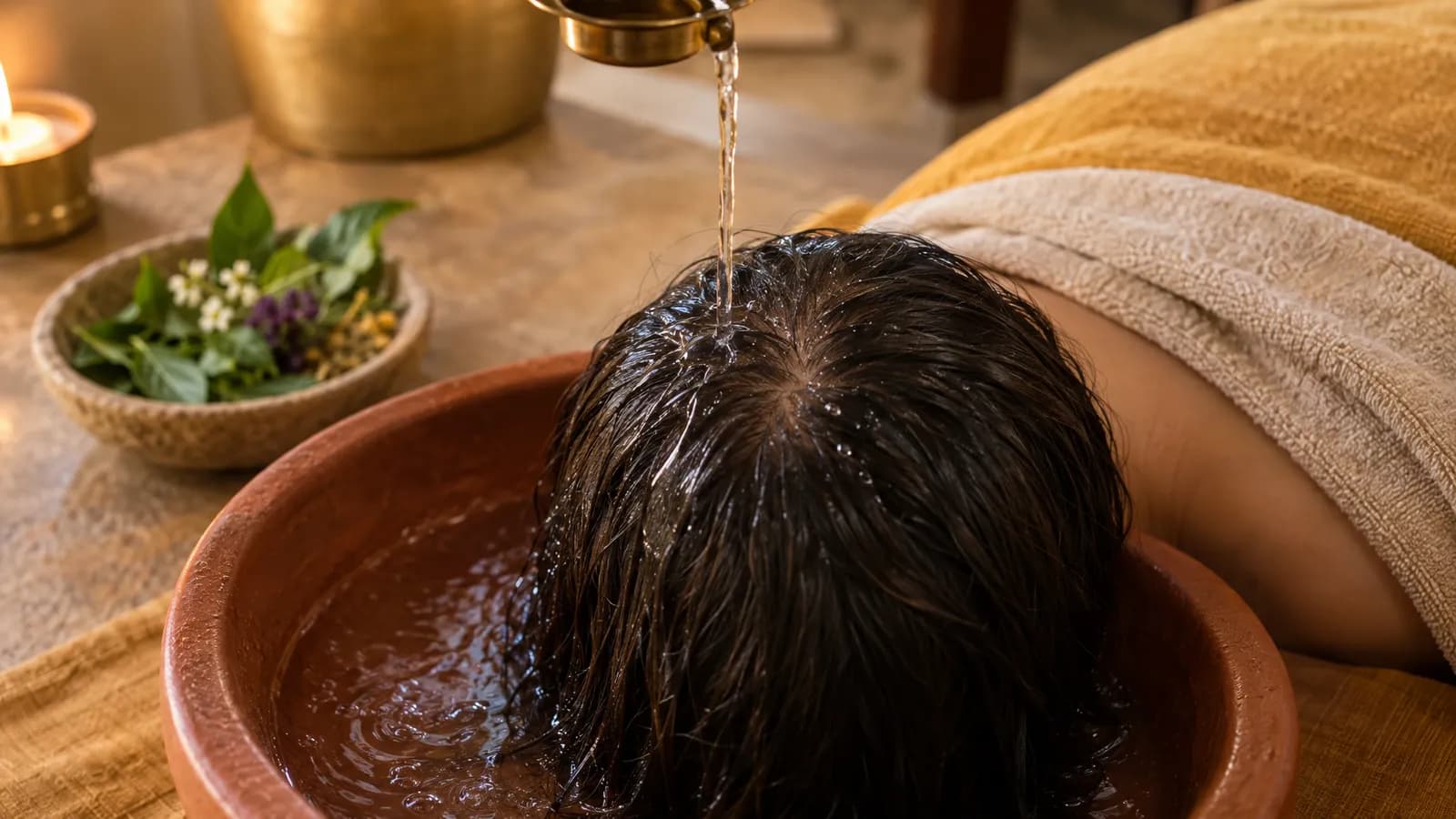
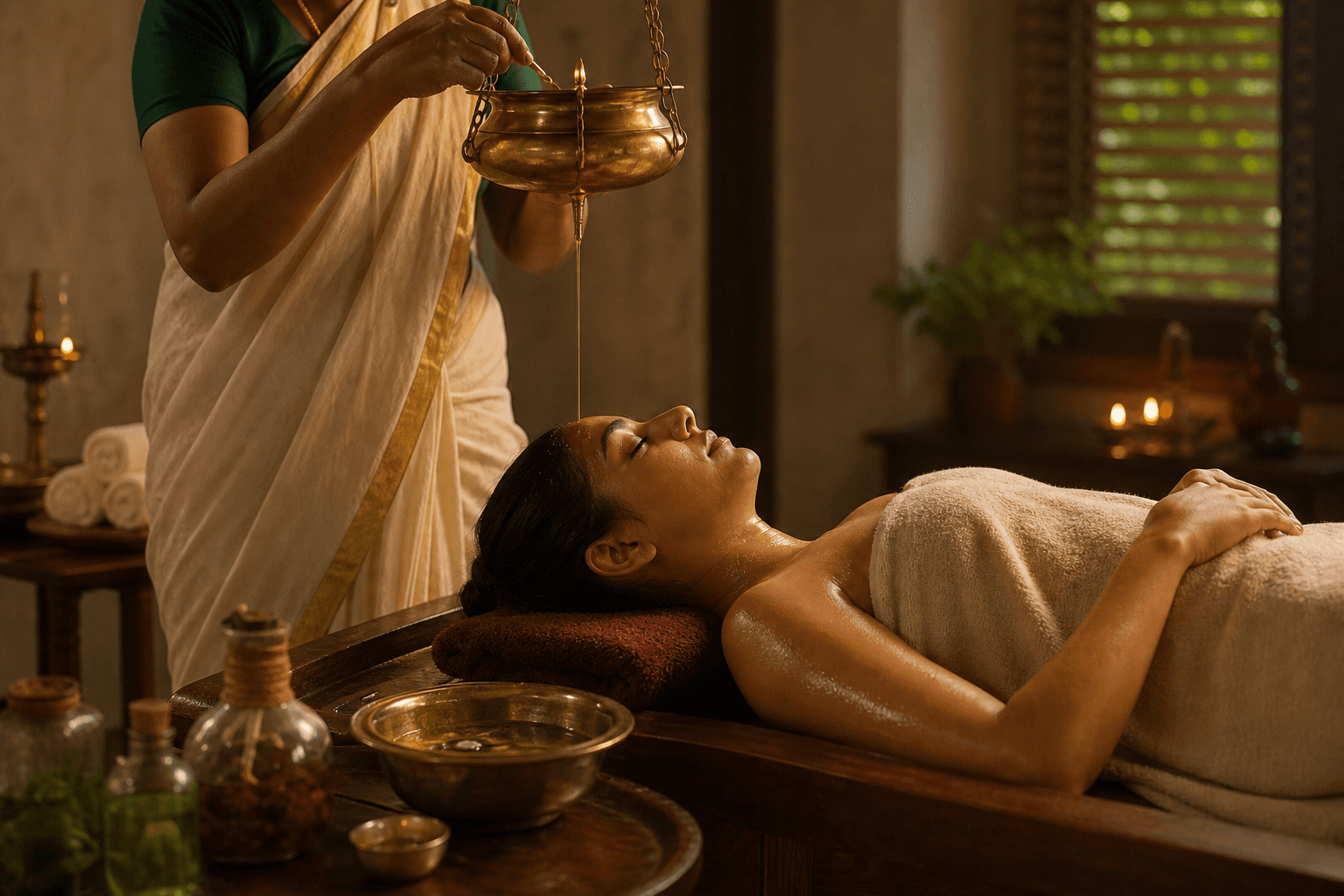
Shirodhara is a treatment in which a steady stream of warm oil is poured onto the forehead. Shanti Dhara's menu describes its Sacred Shirodhara Therapy as using "generous amounts of high-quality Ayurvedic herbal oils" with "the gently heated oil" flowing "steadily onto the Ajna Chakra (third eye)." It is $288 for 75 minutes, or $328 for the 90-minute Full Experience, which the menu says "includes a deeper head massage."
Illustrative image of Shirodhara.
Two small studies have looked at it:
- A 2008 study in the Journal of Alternative and Complementary Medicine ran two experiments. In the first, 16 healthy women had a 30-minute Shirodhara to work out the best treatment conditions. In the second, another 16 healthy women were assigned to either a 30-minute Shirodhara or 30 minutes lying on their backs as a control. The Shirodhara condition showed lower state anxiety and a larger drop in plasma noradrenaline than the control. The abstract does not spell out how many women were in each condition.
- A 2013 open-label study in the Journal of Ayurveda and Integrative Medicine gave 16 healthy volunteers an Abhyanga followed by Shirodhara and compared measurements before and after. Mood and stress scores improved, and breathing rate, heart rate and diastolic blood pressure fell. The authors linked an increase in alpha rhythm on EEG to what they called "a state of alert calmness similar to the relaxation response observed in meditation." There was no control group.
Both studies were small, both were in healthy volunteers, and both measured changes over a single session. They do not show that Shirodhara treats an anxiety disorder or insomnia, and the studies cited here did not compare Shirodhara with Abhyanga or with other kinds of massage.
How Massage Fits With Standard Anxiety Treatment
For generalized anxiety disorder, the National Institute of Mental Health (NIMH) describes cognitive behavioral therapy (CBT) as the "gold standard" psychotherapy: it "helps people become aware of automatic ways of thinking that are inaccurate or harmful" and teaches people to question those thoughts and change problematic behavior patterns. NIMH also lists medications, including SSRI and SNRI antidepressants, which "can help treat the symptoms of GAD."
NIMH adds that "stress management techniques, such as exercise, mindfulness, and meditation, also can reduce anxiety symptoms and enhance the effects of psychotherapy." Massage is not on that list, but it is the category in which Ayurvedic massage fits best: an optional addition to standard care, chosen because you find it relaxing, not a replacement for therapy or medication.
If you are being treated for anxiety, tell your clinician about anything you add, including massage. NCCIH gives the same advice for any complementary approach, and notes that the risk of harm from massage "appears to be low," with rare serious side effects occurring particularly with vigorous deep tissue massage or in vulnerable people such as older adults.
Choosing a Treatment at Shanti Dhara
Because the studies do not match particular treatments to particular kinds of anxiety, choose based on the experience you want:
- Abhyanga Body Treatment: 75 minutes ($228) or 90 minutes ($268). A full-body warm oil massage, if you like massage and want time on the table.
- Sacred Shirodhara Therapy: 75 minutes ($288), or 90 minutes for the Full Experience ($328). Warm oil poured on the forehead, if you want a head-focused treatment. See our Shirodhara page for more.
- Combo Package – Customized Design: 120 minutes, $358, which the menu describes as a treatment "tailored to your Dosha type and chakra balance, combining facial and body therapies." Ask the studio what can be included.
- Shorter options: the 30-minute Nap Break ($98, 8:30 AM) and the 60-minute Relax Therapy ($158, 12:30 PM, with meditation and singing bowl therapy), if a long session feels like too much.
When you book, mention any medications, skin sensitivities or allergies, and anything that would make you more comfortable, such as whether you prefer silence or conversation. For a wider look at the studio's calming treatments, see our guide to Ayurvedic stress relief in Palo Alto.
Shanti Dhara Wellness is at 2875 Middlefield Rd, Suite 8 (2nd floor), Palo Alto. Hours: Tuesday and Sunday 10 AM–4:30 PM, Wednesday–Saturday 10:30 AM–6 PM; closed Monday. Book through the menu or call (650) 283-9121.

FAQ: Ayurvedic Massage and Anxiety
Can Ayurvedic massage replace my anxiety medication?
No. Ayurvedic massage is a complementary wellness practice, not a substitute for medical treatment. If you take medication for anxiety, keep taking it as prescribed and discuss any change with your prescriber.
How soon will I feel results?
The small studies above measured changes right after a single session: lower self-reported stress, slower heart rate and, in the 2008 Shirodhara study, lower state anxiety than a control condition. They do not show whether, or after how many sessions, any change lasts, and massage is not a treatment for an anxiety disorder on its own.
Which is better for anxiety, Abhyanga or Shirodhara?
The studies cited here did not compare them, so there is no evidence-based answer. Choose the one whose experience appeals to you: a full-body oil massage or a head-focused oil treatment.
Will the oil make me break out?
It can if your skin is sensitive to a particular oil. Tell the studio about acne, allergies or skin sensitivities before your session and ask which oils are used.
Can I book this if I'm already in therapy?
Yes. Mention it to your therapist so they know what else you are trying. Massage is not on NIMH's list of stress management techniques, so treat it as an addition you enjoy rather than a replacement for therapy.