Why Shirodhara Isn't Just Another Massage
Shirodhara and massage are both relaxing spa treatments, but they are physically different things. Massage works on the body through hands-on pressure; Shirodhara is a steady stream of warm oil poured onto the forehead, with no kneading or pressure on the muscles. Which one you choose depends mostly on what kind of experience you want.
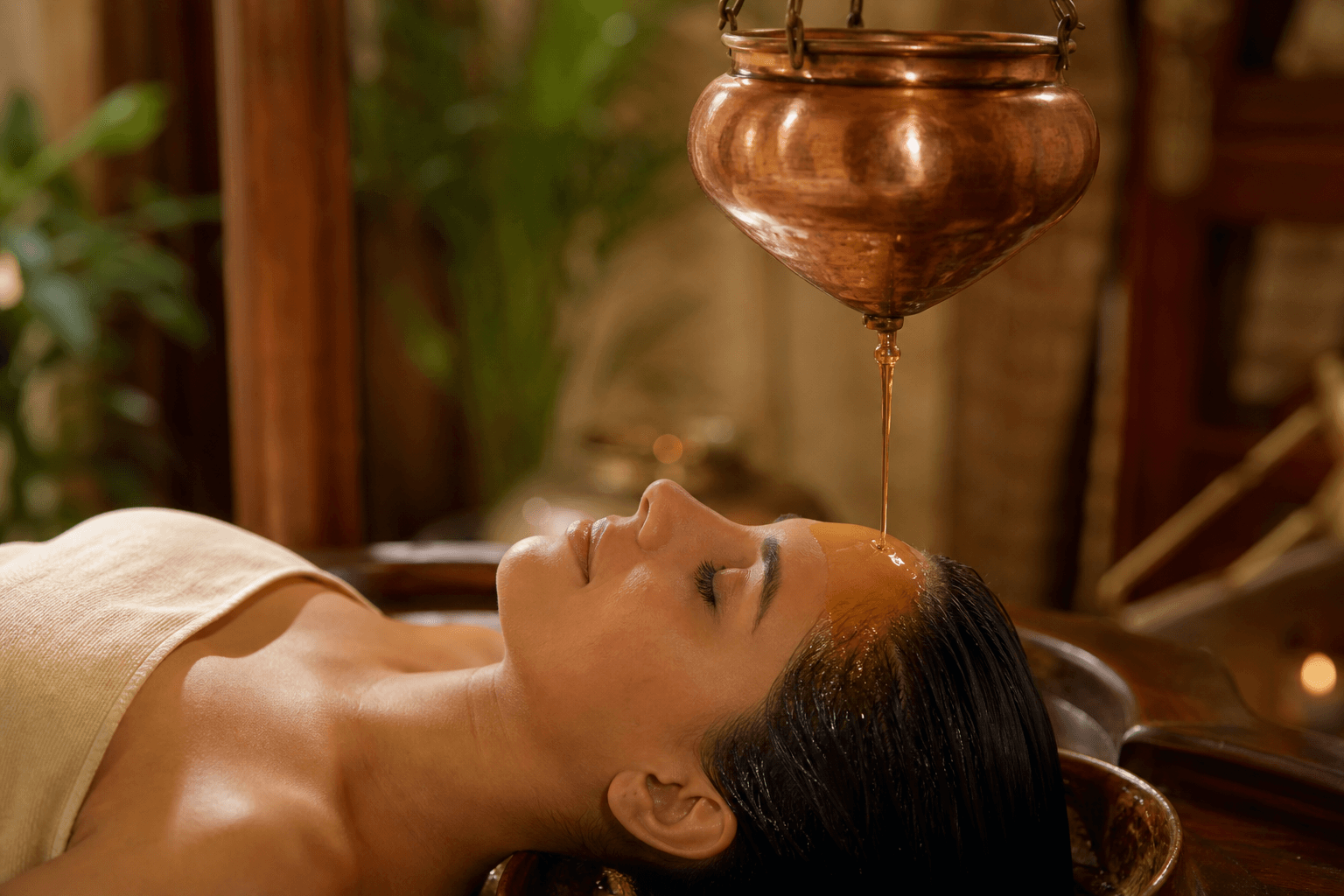
Shirodhara is a traditional Ayurvedic therapy in which a continuous stream of warm herbal oil is poured onto the forehead, over the "third eye" area (the ajna marma point between the eyebrows). A 2013 paper in the Journal of Ayurveda and Integrative Medicine describes it as "a classical and a well-established ayurvedic procedure of slowly and steadily dripping medicated oil or other liquids on the forehead." There's no kneading, no pressure on muscles, no working out knots. The aim is a quiet, still experience rather than work on the muscles.
Massage therapy, as the U.S. National Center for Complementary and Integrative Health (NCCIH) puts it, involves "manipulating the soft tissues of the body." A therapist uses hands-on techniques such as pressure, kneading and stretching on muscles and other soft tissue. The two treatments can sit on the same spa menu, but understanding what physically happens in each helps you choose the one you'll actually enjoy.
How Shirodhara Works, and What the Research Shows
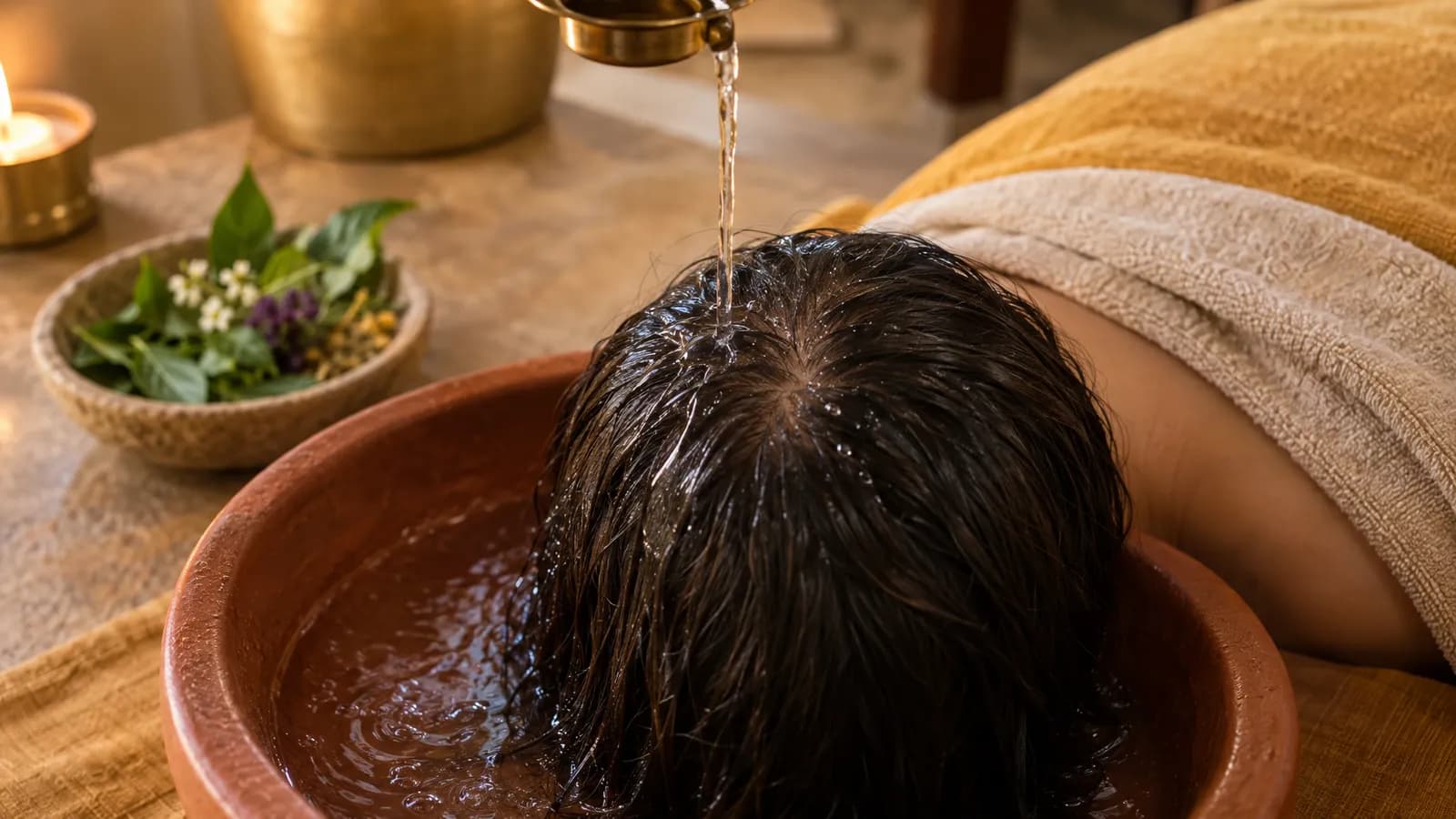
The method is simple: a steady stream of warm oil falls from a vessel above you onto the center of the forehead and runs back across the scalp. That's it — no deep pressure, no joint mobilization, no sports-recovery techniques.
Why some people find it calming is less settled. Ayurveda places the ajna marma point at the center of the forehead and treats the steady, repetitive sensation there as the heart of the therapy. Research is limited. In that 2013 study, an open-label trial with 16 healthy volunteers and no control group, Shirodhara was preceded by Abhyanga (a whole-body oil massage). Afterward, the volunteers' mood scores and stress ratings on validated scales improved, their breathing rate, diastolic blood pressure and heart rate went down, and the EEG alpha rhythm increased; the authors compared the result to the relaxation response observed in meditation. Because the volunteers were healthy, the group was small, there was no comparison group, and Abhyanga came first, the study can't tell you how Shirodhara compares with a regular massage, or whether it helps any particular condition.
The oil itself is part of the experience. At Shanti Dhara Wellness in Palo Alto, Sacred Shirodhara Therapy uses generous amounts of Ayurvedic herbal oil, gently heated and streamed onto the Ajna Chakra (third eye), according to the menu. In Ayurvedic tradition, oils are chosen to suit a person's constitution (dosha); if you're curious, or have allergies or sensitive skin, ask which oil the studio will use.
During Shirodhara, warm herbal oil flows in a continuous stream over the forehead.
Side-by-Side Comparison: Shirodhara vs Regular Massage
Here's how the two treatments differ in what physically happens and what you'll need to plan for:
- What's worked on: Massage works on muscles and other soft tissue. Shirodhara works on no muscle at all; it is a sensory experience centered on the forehead and scalp.
- Technique: Massage uses hands-on pressure, kneading and stretching. Shirodhara uses a steady oil stream with no manual pressure on the body during the pour.
- Touch: Massage involves sustained hands-on contact. The oil-stream portion of Shirodhara involves little direct touch, though sessions may include other hands-on elements; the 90-minute Full Experience at Shanti Dhara adds a deeper head massage.
- What the evidence says: NCCIH reports that massage "may be helpful for neck or shoulder pain, but the benefits may only last for a short time," and that evidence for low-back pain is weak. For Shirodhara, the research is limited to small studies like the one above.
- Duration and price at Shanti Dhara: Sacred Shirodhara Therapy runs 75 minutes ($288), or 90 minutes ($328) for The Full Experience. See the Shirodhara page for booking details.
- Afterward: Shirodhara leaves oil on your forehead and in your hair; ask the practitioner whether and when to wash it out.
The same points as a table:
| Regular massage | Shirodhara | |
|---|---|---|
| What's worked on | Muscles and other soft tissue | No muscle; a sensory experience centered on the forehead and scalp |
| Technique | Hands-on pressure, kneading and stretching | A steady stream of warm oil onto the forehead, with no manual pressure during the pour |
| Touch | Sustained hands-on contact | Little direct touch during the pour; the 90-minute Full Experience adds a deeper head massage |
| Evidence | NCCIH: may help neck or shoulder pain, but the benefits may be short-lived; weak evidence for low-back pain | Limited to small studies, such as a 2013 open-label study of 16 healthy volunteers |
| Afterward | A massage without oil on the head is more practical if you have plans right after | Oil on your forehead and in your hair; ask when to wash it out |
| At Shanti Dhara | Hands-on oil massage: Abhyanga, 75 min ($228) or 90 min ($268) | Sacred Shirodhara Therapy, 75 min ($288); The Full Experience, 90 min ($328) |
In short, the choice is about preference and practicalities: whether you want hands-on bodywork or a still, hands-off sensation, and whether oily hair fits your day. Responses vary from person to person.

Who Might Prefer Shirodhara?
Shirodhara isn't better or worse than massage — it's different. These are preferences worth thinking about, not medical recommendations:
You'd like to lie still. If the idea of lying quietly while warm oil flows over your forehead appeals more than hands working on your muscles, Shirodhara may suit you.
You'd like to try something unfamiliar. If you've had many massages and want a different sensory experience, Shirodhara is a distinct traditional treatment rather than a variation on massage.
You prefer less hands-on contact. Touch preferences vary. The oil stream itself involves no pressure on the body, but ask the studio when you book how much hands-on work the session includes and what you'll wear, since the 90-minute Full Experience adds a deeper head massage.
A note on health conditions. Shirodhara is a spa treatment, not a treatment for anxiety, insomnia, headaches or any other condition. If you're dealing with ongoing sleep problems, anxiety or migraines, talk to your doctor; a spa session can be a relaxing experience alongside that care, not a replacement for it. If you're a tech worker looking at other Ayurvedic options, see this guide to Ayurvedic treatments for tech workers.
When Regular Massage May Suit You Better
There are situations where a massage, or medical care, is the more appropriate choice:
You want hands-on work on a specific area. If you'd like a therapist to work on your neck, shoulders or back, massage does that and Shirodhara doesn't. For pain that is new, severe or doesn't go away, see a health care provider first; NCCIH advises not to delay medical care by relying on massage alone.
You've been told you need lymphatic drainage. Manual lymphatic drainage is a specific technique, not a general spa massage. Cleveland Clinic notes that healthcare providers mainly use it to relieve lymphedema after breast cancer surgery, that it should be avoided with conditions such as blood clots, cellulitis, infection or heart disease, and that it "may not work for everyone." Ask your healthcare provider whether it's appropriate and who should do it. Shirodhara has no lymphatic component.
You don't want oily hair. If you have plans right after your appointment, a massage that doesn't involve oil on the head may be more practical.
You prefer active physical touch. If you enjoy the sensation of hands working on your muscles and Shirodhara's hands-off approach doesn't appeal, there's no reason to force it.
Combining Shirodhara and Abhyanga
You don't have to choose only one. Shanti Dhara's menu includes Abhyanga, a full-body warm herbal oil massage: the Abhyanga Body Treatment is $228 for 75 minutes or $268 for 90. You could book the two on different visits to experience both a hands-on oil massage and the hands-off oil stream. There's no established schedule for alternating them, so book at whatever spacing suits your budget and calendar, and ask the studio if you'd like a suggestion.
What to Ask Before Your First Shirodhara Session
Sessions can differ between studios, so rather than assume a set routine, ask the studio when you book:
- What happens at the start? Whether you'll be asked about health concerns, allergies or skin sensitivities, and how the oil is chosen.
- How long is the oil pour itself, and what else is included in the 75- or 90-minute session.
- What to wear, and how much hands-on work the session includes.
- What happens afterward: whether there's time to rest, how excess oil is removed, whether you can wash your hair at the studio, and when they suggest washing it.
- Anything about your health they should know, including pregnancy, recent surgery, or skin or scalp conditions.
Practical preparation is simple: expect oily hair, wear clothes you don't mind getting oil on, and don't plan anything right afterward that requires freshly washed hair. If you leave with oil in your hair, an old pillowcase or towel protects your bedding, and oil can take more than one shampoo to wash out. Take your time getting up after lying still for a long session.
FAQ: Shirodhara vs Regular Massage
Will Shirodhara mess up my hair?
You'll leave with oil in your hair. Ask the practitioner when they suggest washing it out. When you do, oil can take more than one shampoo to remove; you may prefer to schedule the session late in the day for that reason.
Can I get Shirodhara if I'm pregnant?
If you're pregnant, tell the studio when you book and check with your OB-GYN first. You can reach Shanti Dhara at (650) 283-9121.
How is Shirodhara different from a scalp massage?
A scalp massage involves hands-on kneading and pressure. The Shirodhara pour is hands-off — the oil stream is the treatment. In Ayurveda, the focus is the sustained, rhythmic sensation at the ajna marma point rather than manual manipulation.
Do I need to do multiple sessions, or is one enough?
Responses and preferences vary, and there's no good evidence on how many sessions are needed. One session is a reasonable way to find out whether you like it.
Can I drive home after Shirodhara?
Only drive when you feel fully alert. If you feel drowsy or unsteady after lying still for a long session, wait until that passes, or arrange another way home.