Your Body Keeps a Record of Your Desk Job
Long days at a computer can leave you with a familiar set of complaints: a stiff or sore neck, shoulders that creep forward, a lower back that aches by mid-afternoon, and sometimes headaches. Not everyone gets all of them, and the causes vary from person to person. Ayurvedic bodywork such as Abhyanga, a warm herbal oil massage, is one way some desk workers choose to unwind that tension. It is not a treatment for a diagnosed condition, and it sits alongside, not in place of, good ergonomics and medical care.
If desk work leaves your neck and back stiff, the options to consider include adjusting your chair and screen, a standing desk, regular stretching breaks, massage and, when symptoms persist or worsen, a doctor or physical therapist. This post explains what the posture side of desk work looks like, what the Ayurvedic body treatments on Shanti Dhara's menu actually include, and how to decide whether one is worth trying. For background on the treatments themselves, see our posts on Abhyanga and Podikizhi and Kati Vasti.
What Screen Posture Can Do to Your Neck and Shoulders
Desk work rarely injures you the way a fall or a sports collision does. The strain tends to build through hours spent in one position, especially when your head drifts forward toward a screen.
Tech neck: Cleveland Clinic describes "tech neck" as a repetitive-use injury that comes from tilting your head forward to look at a device. It compares the head to a 10- to 12-pound bowling ball and notes that the load your neck feels grows as the head tilts further forward. As you hunch, it adds, your shoulders round, putting extra pressure on the whole upper body.
Symptoms people report: The same Cleveland Clinic article lists stiffness, soreness or sharp pain in the neck and shoulders, and headaches. It also lists numbness and tingling in the arm, hand and fingers. If you have that last group of symptoms, see a clinician rather than booking a massage.
Lower back: Many desk workers also notice lower back discomfort after long stretches in a chair. Back pain can have many causes, so if it is persistent, sharp, or spreading down a leg, get it assessed before you choose any kind of bodywork.
Stress load: Deadlines, notifications and back-to-back meetings add a mental layer that many desk workers describe alongside the physical one. Part of the appeal of slow, warm-oil treatments is simply that they give you an hour away from the screen.
Neck and shoulder stiffness is a common complaint among people who spend long hours at a screen.
Simple Desk Habits That Help
No massage can undo a setup that keeps pulling your head forward all day. Cleveland Clinic's prevention tips for tech neck are practical and cost nothing:
- Raise the screen: bring devices up to eye level so you are not tilting your head down to read.
- Move regularly: change positions about every 20 minutes.
- Limit handheld sessions: keep stretches of phone or tablet use to roughly 15 to 30 minutes.
- Go hands-free for calls: a phone stand with speaker or headphones saves you from cradling the phone.
Treat bodywork as something you add on top of habits like these, not as a replacement for them.
Abhyanga: A Full-Body Warm Oil Massage
During an Abhyanga session at Shanti Dhara Wellness in Palo Alto, your practitioner applies warm herbal oil in long strokes. The menu describes it as a flowing warm herbal oil massage that balances the doshas, removes Ama and enhances Ojas — traditional Ayurvedic concepts, not clinical measurements. The menu also says it improves lymph flow; lymph flow is a measurable physiological process, but that line is the menu's description, and this post does not cite a study showing the effect. Compared with a deep tissue massage built around firm pressure on knots, Abhyanga relies more on warmth, oil and a slow, flowing pace.
What the evidence says so far is limited. In a small 2011 pilot study, 20 healthy adults reported significantly less stress, and had lower heart rates, after a single one-hour Abhyanga. There was no control group, so treat it as an early signal rather than proof, and note that it did not study neck or back pain.
If your neck and shoulders are where you carry tension, tell your therapist at the start and ask how they can spend time there; if your lower back or hips bother you, say that too. Asking is better than assuming, because the menu describes the treatment as a full-body oil massage and does not list a fixed focus area.
Shanti Dhara offers Abhyanga in 75-minute ($228) and 90-minute ($268) formats. If you want time for several areas, the 90-minute session is simply longer.

Kati Vasti: Warm Oil Over the Lower Back
If your lower back is the main complaint, Kati Vasti is the menu item that focuses there. The menu describes it as a lower back therapy that combines Abhyanga massage with Kati Vasti, where warm herbal oil pools over the lumbar area to nourish bones, nerves and tissues and relieve Vata-related tension. As with Abhyanga, the nourishing and Vata language comes from Ayurvedic tradition rather than clinical trials.
At Shanti Dhara, Kati Vasti is offered combined with Abhyanga: Abhyanga + Kati Vasti runs 75 minutes ($258) or 90 minutes ($298). Ask the studio how the session is structured if you want to know what to expect. For persistent or sharp back pain, see a doctor first; warm oil is a comfort measure, not a diagnosis.
Shirodhara: Warm Oil for a Quiet Mind
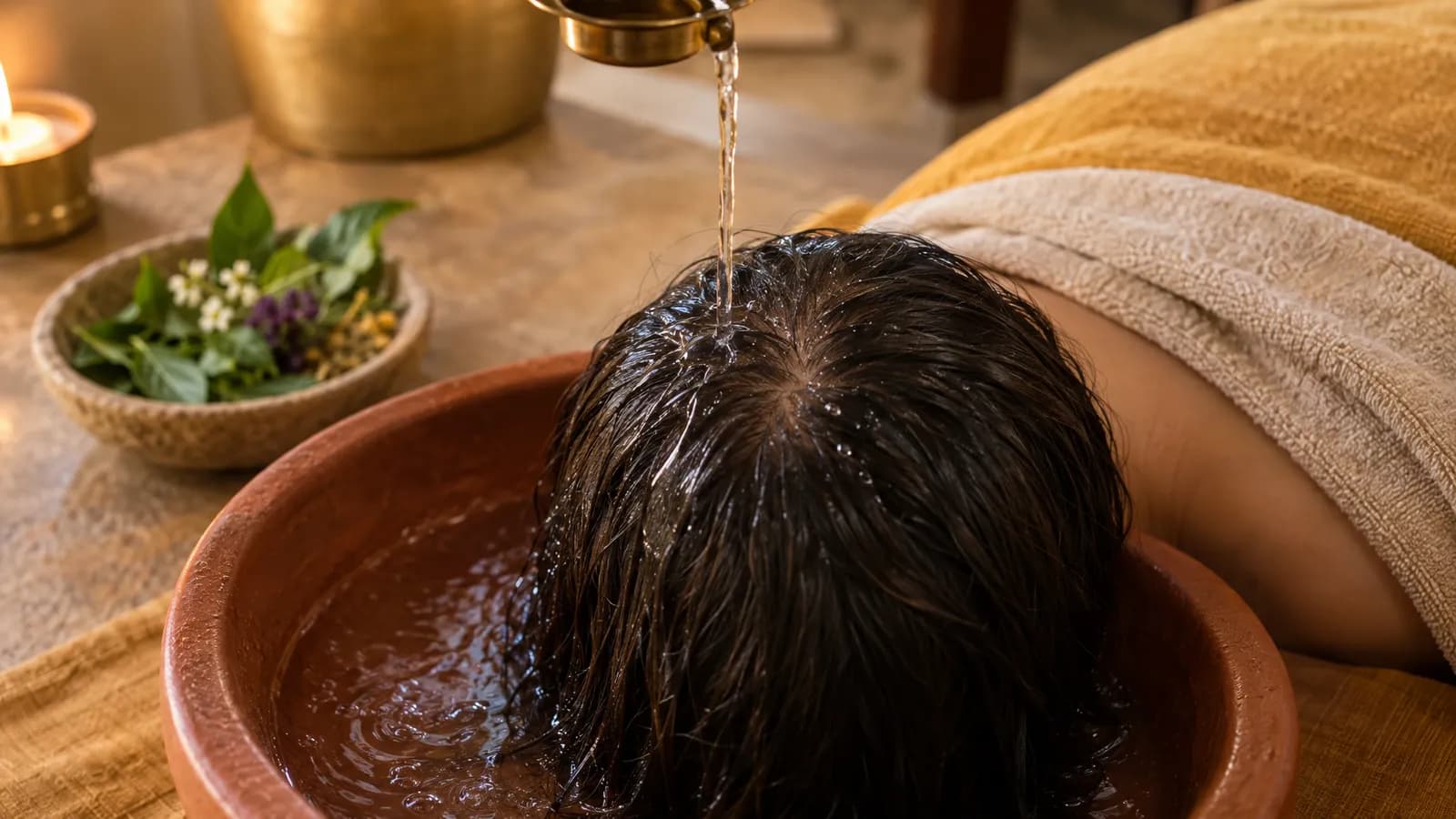
Some desk workers are less bothered by a sore neck than by a mind that will not switch off after a long week. Shirodhara is the treatment on the menu aimed at that feeling. The menu describes gently heated herbal oil flowing steadily onto the Ajna Chakra, the "third eye" point on the forehead. The idea is that lying still under a steady, warm stream of oil helps you settle.
The research is thin and preliminary. In one open-label 2013 study in the Journal of Ayurveda and Integrative Medicine, 16 healthy volunteers (no control group) had lower stress ratings, slower breathing and heart rate, and more EEG alpha rhythm after Abhyanga followed by Shirodhara. It did not test Shirodhara on its own, and its volunteers were healthy, so it says nothing about anxiety or insomnia.
Part of the appeal for a busy mind is that the constant background hum of deadlines and messages gets something to compete with: a single, continuous sensation to focus on. If meditation apps haven't worked for you, it's an option that doesn't ask you to relax through willpower; you just lie still. Some people find that helps their mind settle.
How people respond varies, and a spa treatment is not a treatment for insomnia or anxiety. If sleep problems or anxiety are persistent, talk with your doctor; Shirodhara can be something you enjoy alongside that care.
Shanti Dhara offers Shirodhara as a 75-minute treatment (Sacred Shirodhara Therapy, $288) or a 90-minute Full Experience with a deeper head massage and scalp and hair care ($328). If what you want is quiet rather than work on sore muscles, this is the one to look at first. Our post on Shirodhara vs Abhyanga compares the two.
Podikizhi and Forearm Tightness
If you type for a living, tight forearms and wrists can come with the job. Numbness, tingling, or pain that persists (for example, possible carpal tunnel syndrome or tendinitis) needs a doctor's assessment, not bodywork.
For everyday stiffness, Podikizhi is a heat-based option. The menu describes it as Abhyanga combined with Podikizhi herbal poultice therapy, in which warm herbal bundles are gently pressed across the body to ease Vata-related muscle stiffness and joint discomfort. If your forearms and hands are what feel tight, say so at the start so the therapist knows where you would like attention.
At Shanti Dhara, Podikizhi is offered combined with Abhyanga: Abhyanga + Podikizhi runs 75 minutes ($258) or 90 minutes ($298).
How Often to Book
There is no evidence-based schedule for spa bodywork, so how often you go is a matter of preference and budget. Some people like a regular slot, such as once a month, simply because it is easier to protect time that is already on the calendar. Others book around busy stretches at work, like a launch or quarter-end. Either approach is fine; neither has been shown to work better.
If you tweak your back, get a severe headache, or wake up with your neck locked, check with a doctor or physical therapist first, especially for pain that is severe, spreading, or comes with numbness. Bodywork fits better once you know what you are dealing with.
Before Your First Session at Shanti Dhara
If you have never had Ayurvedic bodywork, a few things help:
Tell your therapist what is going on: mention your symptoms, any injuries, chronic conditions, allergies, skin sensitivities, or pregnancy, and which areas you would like attention on.
Ask about comfort: if you run cold, or want more or less pressure in a particular area, say so. The studio can tell you what is possible for the treatment you booked.
What to wear: comfortable, loose clothing you don't mind getting a little oily, especially for Abhyanga or Podikizhi. Ask the studio when you book what to expect about undressing and draping.
Allow time afterward: these treatments use a lot of oil. Ask your therapist how they recommend handling the oil and the rest of your day, and follow the guidance they give you for your skin.
Location and hours: the studio is at 2875 Middlefield Rd, STE 8, 2nd floor, Palo Alto. It is open Tuesday through Sunday and closed Mondays.
Cost, Insurance, and FSA Eligibility
The body treatments in this post cost $228 to $298 (Abhyanga and its combinations) and $288 to $328 (Shirodhara) at Shanti Dhara.
Check with your insurer about coverage. For an HSA (Health Savings Account) or FSA (Flexible Spending Account), check with your plan administrator: IRS Publication 502 counts only expenses primarily meant to alleviate or prevent a physical or mental illness, not those merely beneficial to general health, so a plan may ask for a letter of medical necessity from your doctor. Ask the studio whether it can provide an itemized receipt.
FAQ: Ayurvedic Massage for Desk Workers
How is Ayurvedic massage different from Swedish or deep tissue?
The most visible difference is the oil: treatments like Abhyanga use generous amounts of warm herbal oil and a slow, flowing pace. They are also described in Ayurvedic terms, such as balancing the doshas, which are traditional concepts rather than measured effects. Swedish and deep tissue massage are described in terms of muscles and pressure. Which you prefer is personal; one is not proven better than the other.
Will I be too relaxed to work afterward?
Responses vary. Some people feel sleepy or slow after a long, warm oil treatment, and others feel ready to get on with the day. If you are not sure how you will react, book your first session at a time when you do not have demanding work straight after (the studio is open Tuesday through Sunday and closed Mondays).
How often should I go?
There is no fixed rule. Pick a rhythm you can afford and enjoy. If you are dealing with a chronic issue such as migraines, lower back pain or insomnia, work with your doctor, and talk with your therapist about what fits alongside that care.
Do I need to know my dosha type before booking?
No. If you know your type, mention it when you arrive. If you are curious, our guide to understanding your dosha explains the idea, but it is not required.
Can I get these treatments if I have an injury or medical condition?
Call ahead at (650) 283-9121 to ask, and check with your doctor for a recent injury. If you are seeing a physical therapist or doctor for an issue, mention it before your session so the therapist knows.