The spa treatment that runs warm oil onto the center of your forehead is Shirodhara. Abhyanga is a full-body warm herbal oil massage. Shirodhara is a quiet, mostly hands-off session built around a steady stream of oil on the point between your eyebrows, while Abhyanga is hands-on massage over your whole body. The practical choice is whether you want stillness centered on your head or touch from head to toe. At Shanti Dhara Wellness in Palo Alto, Sacred Shirodhara Therapy is $288 for 75 minutes and the Abhyanga Body Treatment is $228 for 75 minutes, and you can book either one on its own.
You may also see the word Shirobhyanga (or "shiro abhyanga"). It's the Ayurvedic name for a head oil massage, done with hands rather than a poured stream, so it isn't the same thing as Shirodhara. It isn't a separate item on Shanti Dhara's menu; the 90-minute Shirodhara Full Experience ($328) adds a deeper head massage. If the pour and the full-body work are both on your mind, our Shirodhara vs regular massage guide covers the other half of the comparison.
Two Ayurvedic Treatments, Very Different Experiences
Shirodhara and Abhyanga are both Ayurvedic oil-based treatments. They both involve warm herbal oils, and if you've never tried either one, they can look interchangeable on a spa menu. But what you actually feel in each is quite different.
Shirodhara is a focused head treatment. Shanti Dhara's menu describes gently heated oil that "flows steadily onto the Ajna Chakra (third eye)," the point Ayurveda places between the eyebrows. You lie still while the oil flows. In Ayurvedic tradition it is associated with calming the mind, and the small amount of research on it has looked mainly at relaxation and anxiety, as the research section below explains.
Abhyanga is a full-body oil massage. The menu describes it as "a flowing warm herbal oil massage." It's physical and tactile: you feel hands working warm oil over your body. Ayurvedic tradition associates it with the body more than the mind, and it's the one to consider if you'd enjoy a full-body massage.
At Shanti Dhara Wellness, both treatments are available individually. If you're choosing one to start with, a useful question is which experience appeals to you more: stillness and a warm stream on your forehead, or a hands-on full-body massage. This guide breaks down the differences so you can pick.
What Happens During a Shirodhara Session
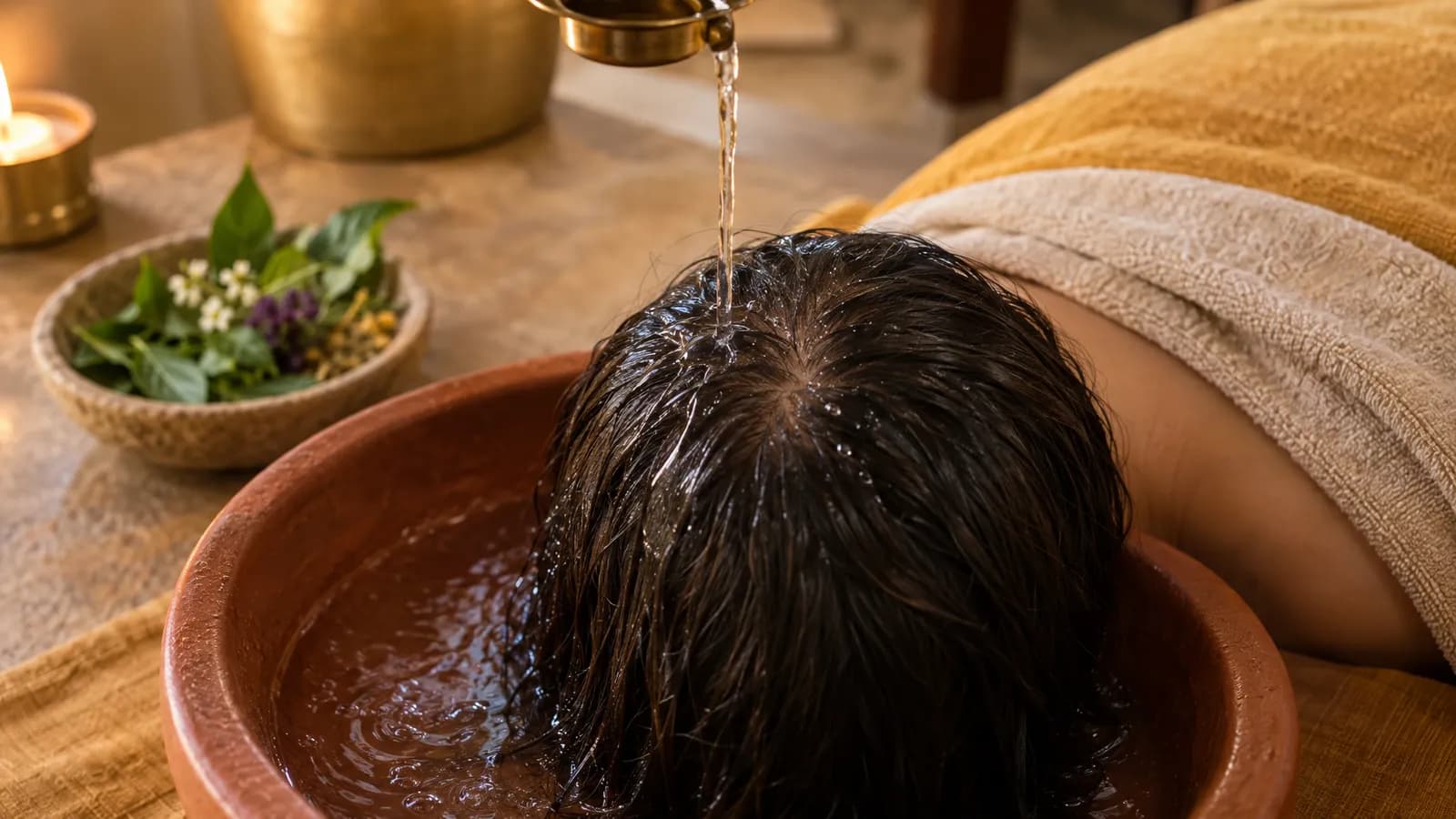
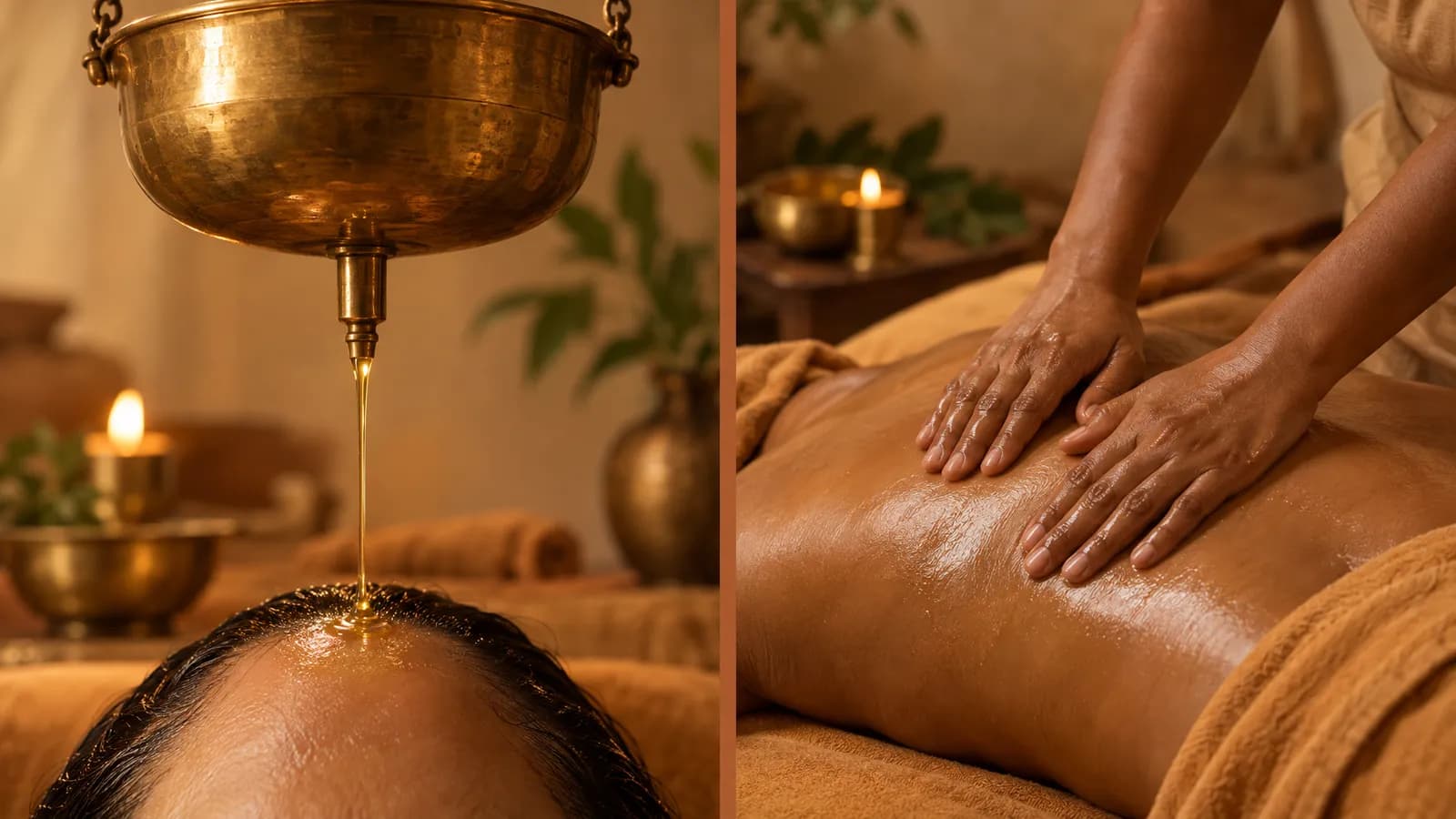
Shirodhara combines "shiro" (head) and "dhara" (flow). The technique at its center is a thin, steady stream of warm herbal oil poured across the forehead from a vessel suspended above you, while you lie face-up. There's no deep tissue work or stretching in the pour itself.
Shanti Dhara's menu describes the 75-minute Sacred Shirodhara Therapy as using "generous amounts of high-quality Ayurvedic herbal oils, combined with the Shirodhara warm oil therapy," with the gently heated oil flowing onto the third eye. The 90-minute Full Experience ($328) "includes a deeper head massage and enhanced repair for the scalp and hair." The menu doesn't spell out the rest of the session, such as whether there is massage before or after the pour in the 75-minute version, so ask the studio if you'd like to know how the time is used.
The steady, warm stream is meant to be restful, though experiences vary. Your hair will be thoroughly oiled afterward, so plan to wash it at home. For a detailed walkthrough, read our Shirodhara guide.
Warm herbal oil flowing onto the forehead during a Shirodhara treatment.
What Happens During an Abhyanga Session
Abhyanga means "oil massage," and the treatment is exactly that: a full-body massage with warm herbal oil. Shanti Dhara's menu calls it "a flowing warm herbal oil massage" and, in Ayurvedic terms, says it "balances Doshas, improves lymph flow, detoxifies the body (removing Ama), and enhances life force (Ojas)." Those are traditional Ayurvedic descriptions, not tested medical effects.
The menu doesn't say which oils the studio uses, so if you have a preference, an allergy or sensitive skin, ask before you book which oil will be used and whether there are alternatives.
Abhyanga at Shanti Dhara runs 75 minutes ($228) or 90 minutes ($268). There is also a combined Abhyanga + Podikizhi treatment ($258 for 75 minutes, $298 for 90), in which, in the menu's words, "warm herbal bundles are gently pressed across the body to ease Vata-related muscle stiffness." Afterward, your skin will be oily; ask your therapist about showering and what to wear home. For more details, see our complete Abhyanga guide.

Head-to-Head: Key Differences Compared
Seeing both treatments side by side makes the decision easier. Here's how Shirodhara and Abhyanga compare on the practical points:
| Shirodhara | Abhyanga | |
|---|---|---|
| Treatment area | The forehead, with oil running into the scalp and hair | The body |
| Primary technique | A continuous oil pour from a suspended vessel | Hands-on massage strokes with warm herbal oil |
| What it feels like | Mostly still and passive | Active, full-body touch |
| Level of touch | The pour itself is hands-off; the 90-minute Full Experience adds a deeper head massage | Full-contact massage |
| Afterward | Hair saturated with oil; plan to wash it at home | Skin oily; plan time to shower |
| Session length and price at Shanti Dhara Wellness | 75 min, $288; Full Experience 90 min, $328 | 75 min, $228; 90 min, $268 (with Podikizhi: $258 / $298) |
| Research | A 2008 study of 16 healthy women found lower anxiety after one session versus lying down | A 2011 pilot of 20 healthy adults found lower stress and heart rate, with no control group |
| Who might prefer it | You'd like a quiet, lie-still experience and don't mind oily hair | You enjoy massage and want the whole body worked |
The treatments aren't mutually exclusive. You can book them on different days and see which you prefer.
What the Research Does and Doesn't Show
Research on both treatments is small, and none of it shows that one is better than the other for any condition:
- Shirodhara: a 2008 study randomized 16 healthy women to a 30-minute Shirodhara session or to lying down without it; the Shirodhara group reported lower anxiety afterward.
- Abhyanga then Shirodhara: a 2013 open-label study gave 16 healthy adults Abhyanga followed by Shirodhara and found better mood and stress scores and lower heart rate and breathing rate after the sessions. There was no control group, so it can't separate the effect of the treatments from simply resting.
- Abhyanga: a 2011 pilot study of 20 healthy adults found lower self-reported stress and heart rate after a single one-hour session, again with no control group.
These studies suggest the sessions can be relaxing for healthy people. They don't show that either treatment treats insomnia, anxiety, headaches, circulation problems or arthritis. If you're dealing with any of those, see your doctor; the U.S. National Center for Complementary and Integrative Health (NCCIH) advises: "Don't use massage therapy to postpone seeing a health care provider about a medical problem."
Choosing Between Them
Because the evidence doesn't favor one over the other, choose by the experience you want:
- Consider Shirodhara if you'd like to lie still with minimal hands-on contact, if the idea of a warm stream on your forehead appeals to you, and if oily hair afterward is fine.
- Consider Abhyanga if you enjoy massage, want your whole body worked with warm oil, and prefer an active, tactile session. If stiffness is what bothers you, the menu's Abhyanga + Podikizhi adds warm herbal bundles.
- Check with your doctor first if you have a medical condition, varicose veins, a clotting disorder, inflammatory arthritis or a skin condition, or if you're pregnant.
If you're unsure, try one, then the other on another visit. The menu does not specify a required order or schedule; ask the studio how to plan separate visits.
Can You Combine Shirodhara and Abhyanga?
In traditional Ayurvedic practice, Abhyanga is often given before Shirodhara; the 2013 study above used that sequence. At Shanti Dhara Wellness, the 120-minute Combo Package – Customized Design ($358) combines facial and body therapies tailored to your dosha type and chakra balance; ask the studio whether Shirodhara can be included.
You can also book the two on separate days. The studio is open Tuesday through Sunday and closed Monday, so, for example, Abhyanga on a Tuesday and Shirodhara later that week both fit its hours.
If your budget covers only one, choose the experience that appeals to you more, using the comparison above.
Cost and Session Lengths at Shanti Dhara Wellness
Here are the current Shanti Dhara Wellness prices for the treatments in this comparison:
- Sacred Shirodhara Therapy (75 minutes): $288. Warm herbal oil streamed onto the forehead (third eye).
- Sacred Shirodhara Therapy – The Full Experience (90 minutes): $328. Adds a deeper head massage and scalp and hair care.
- Abhyanga Body Treatment: $228 for 75 minutes, $268 for 90 minutes. Full-body warm herbal oil massage.
- Abhyanga + Podikizhi: $258 for 75 minutes, $298 for 90 minutes. Adds warm herbal poultice therapy.
The 120-minute Combo Package – Customized Design ($358) combines facial and body therapies tailored to your dosha. See the current service menu for everything else.
FAQ: Shirodhara vs Abhyanga
Which treatment is better for stress relief?
Research doesn't show one is better. Small studies of healthy adults found lower self-reported stress or anxiety after Abhyanga and after Shirodhara, but none compared the two. Choose by the experience you prefer: stillness and a forehead pour, or a full-body massage. For ongoing stress, anxiety or sleep problems, talk with your doctor too.
Will my hair be oily after Shirodhara?
Yes. The oil flows over your forehead into your scalp and hair during the treatment, so plan to wash your hair at home afterward. Bring a headband or hair tie if you want to contain it on your way home.
What types of massage can I choose from?
At Shanti Dhara Wellness, the massage-style treatments are all Ayurvedic and oil-based: the Abhyanga Body Treatment (a full-body warm herbal oil massage, $228 for 75 minutes or $268 for 90), Abhyanga + Podikizhi ($258 for 75 minutes, $298 for 90), which adds warm herbal bundles pressed across the body, and Abhyanga with Kati Vasti (same prices), which pools warm oil over the lower back. Shirodhara is not a massage; it's a poured stream of oil on the forehead, with a deeper head massage added in the 90-minute Full Experience ($328). The menu doesn't list other massage styles such as deep tissue. See the full menu for everything on offer.
What are traditional Indian Ayurvedic treatments?
Ayurveda is a traditional medical system from India, and its treatments include oil therapies such as Abhyanga (full-body oil massage), Shirodhara (oil poured on the forehead), Podikizhi (warm herbal bundles) and Kati Vasti (warm oil pooled over the lower back). Other traditional treatments include Panchakarma detoxification programs, Nasya (nasal oil therapy) and Marma therapy (work on vital points). Shanti Dhara offers the oil therapies named above in a spa setting; it does not offer Panchakarma, Nasya, Marma therapy or clinical consultations.
What spa treatment involves running warm oil on the center of the forehead?
Shirodhara is the Ayurvedic spa treatment where warm herbal oil streams continuously onto the center of the forehead, the point between the eyebrows that Ayurveda calls the ajna or third eye. The oil flows from a vessel suspended above you while you lie still, rather than working muscles the way a body massage does. At Shanti Dhara Wellness in Palo Alto, Sacred Shirodhara Therapy runs 75 minutes ($288), and the Full Experience runs 90 ($328).