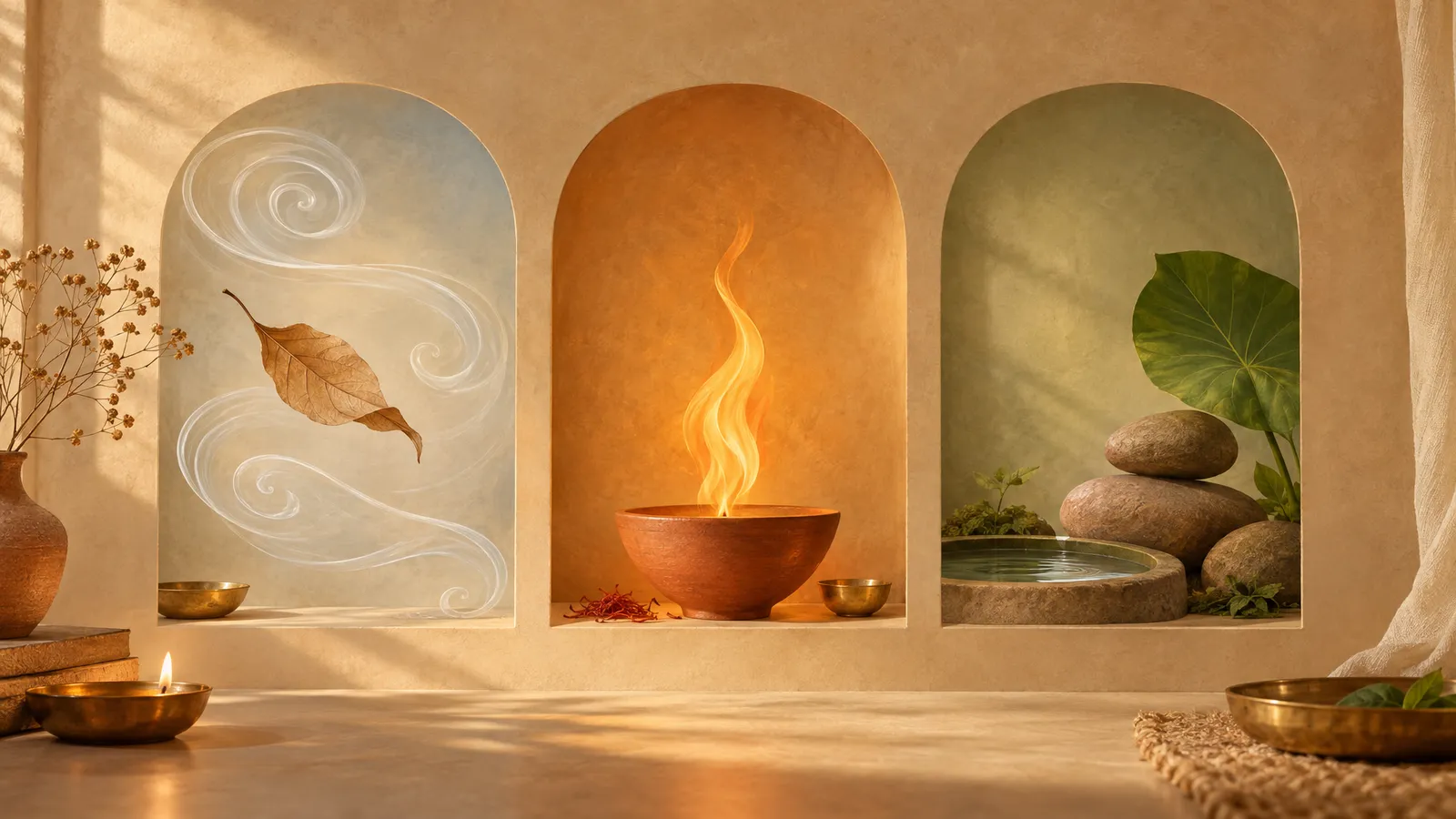
In Ayurveda, a dosha is one of three principles said to govern body and mind. Vata (space and air) is associated with movement, pitta (fire and water) with digestion and metabolism, and kapha (earth and water) with structure and stability. Everyone is described as having all three, and your personal mix is called your prakriti. It's a traditional framework for self-understanding, not a medical diagnosis.
This guide explains each dosha, the difference between your constitution and your current state, a short self-reflection quiz, what genetic research has (and hasn't) found, and the safety points worth knowing before you act on dosha advice.
The Three Doshas at a Glance
These descriptions follow Cleveland Clinic's overview of Ayurveda and The Ayurvedic Institute's introductory guide. They're traditional descriptions, not medical findings.
Vata: space and air
Cleveland Clinic describes vata as controlling the flow of movement in body and mind. Vata-dominant people are traditionally described as creative and flexible, with dry skin and hair, variable appetite and digestion, and a tendency to tire easily. The Ayurvedic Institute says they usually grasp concepts quickly and forget them just as quickly. Out of balance, vata is linked with fear, nervousness and anxiety. The traditional advice is grounding: a regular sleep and meal schedule, meditation and rest.
Pitta: fire and water
Pitta, loosely translated as "fire," is said to govern digestion, hormones and metabolism. Pitta types are typically described as confident, focused leaders with a strong appetite and a medium build, who can become quick to anger. Cleveland Clinic notes that Ayurveda links pitta imbalance with inflammation, rashes, skin conditions such as eczema or acne, and digestive issues.
Kapha: earth and water
Kapha is "the element that holds everything together," from cells to muscles, bones and ligaments. Kapha types are described as loyal, calm and routine-loving, with well-developed muscles, oily and smooth skin, and deep, prolonged sleep. The Ayurvedic Institute describes them as slow to comprehend but with excellent long-term memory. Imbalance is linked in Ayurveda with fatigue, weight gain, swelling and a lack of interest in new activities.
Prakriti vs Vikriti: Your Baseline vs Your Current State
Two readings matter in Ayurveda, and people often mix them up.
- Prakriti is your constitution. The Ayu review describes it as set at conception and unchanged over your lifetime. Cleveland Clinic says Ayurveda holds that prakriti shapes your physical, psychological, behavioral and immunological traits.
- Vikriti is your current state of balance or imbalance. The Ayurvedic Institute describes it as fluctuating with diet, lifestyle, seasons, stress, environment and life stage. Its analogy: prakriti is your baseline blueprint, vikriti your present-day weather.
So a naturally steady, kapha-leaning person going through a sleepless, high-pressure quarter might show up with "vata" signs such as racing thoughts and poor sleep. In Ayurvedic thinking, the care that suits them that month follows the weather, not the blueprint.
Most people aren't one pure type. The Ayu review lists seven constitutional categories: three single-dosha types, three dual types (vata-pitta, vata-kapha, pitta-kapha) and one balanced type with all three in equal measure.
A Quick Self-Reflection Quiz
This isn't a validated test. It's a way to see which traditional description sounds most like you. Answer for how you've been for most of your life, not how you feel this week. Note which dosha you pick most often.
| Trait | Vata | Pitta | Kapha |
|---|---|---|---|
| Skin | Dry | Warm; ruddy, freckles or moles | Oily, smooth |
| Appetite | Variable | Strong, good digestion | Slow metabolism |
| Sleep | Needs more rest | Sound, medium length | Deep, prolonged |
| Learning and memory | Grasps quickly, forgets quickly | Alert, good comprehension | Slow to comprehend, excellent memory |
| When out of balance | Fearful, nervous, anxious | Agitated, quick to anger | Lethargic, possessive |
If two columns come out close, you identify with two of the traditional descriptions. The tradition recognizes dual types for exactly that. If your answers change a lot depending on whether you think of "usually" or "lately," that gap is roughly what Ayurveda means by vikriti.
What Research Says About Doshas
Some researchers have tested whether prakriti types have a measurable biological basis, with intriguing but early results:
- A 2008 study in the Journal of Translational Medicine compared people classified as the three most contrasting types. It found differences in genome-wide gene expression and in biochemical and blood measures, including liver function tests, lipid profiles and hemoglobin.
- A 2015 study in Scientific Reports analyzed the DNA of 262 men carefully classified from a pool of 3,416. It found 52 genetic variants that differed between vata, pitta and kapha groups and could sort people into their groups.
Those studies suggest the traditional classification captures some real biological variation. They don't show that dosha-based diets or treatments improve health. Cleveland Clinic puts it plainly: very few rigorous studies meeting Western scientific standards have been done on Ayurveda, and even fewer show effectiveness. The U.S. National Center for Complementary and Integrative Health (NCCIH) likewise says few well-designed trials suggest Ayurvedic approaches work, and that most are small or poorly designed. Treat your dosha as a lens for noticing patterns, not as a diagnosis.
Using Dosha Ideas in Daily Life
Traditional dosha advice is mostly about routine and food. Cleveland Clinic summarizes it this way:
- Vata: regular meal and sleep times, plus meditation, rest and relaxation to feel grounded.
- Pitta: cooler foods, or a Mediterranean-style diet aimed at calming inflammation.
- Kapha: lighter fare, such as fruits and vegetables in smaller portions.
Most of that overlaps with ordinary good habits, which is part of its appeal. Where it's worth slowing down is supplements.
Safety: Where Dosha Advice Can Go Wrong
Adjusting meal timing is a modest change for most people, though allergies and health conditions still matter for anything you put on or in your body. Ayurvedic medicines taken by mouth deserve the most caution. NCCIH warns that some Ayurvedic preparations may contain lead, mercury or arsenic in amounts that can be toxic. Cleveland Clinic reports that roughly 20 percent of Ayurvedic medicines on the market and online contain potentially harmful levels of those metals, and advises talking with your health care provider before starting any supplement. NCCIH also notes that no U.S. state requires Ayurvedic practitioners to be licensed, so ask about training. And if you have a health condition, don't let a dosha label stand in for a medical workup.
How Doshas Show Up at Shanti Dhara Wellness
At Shanti Dhara in Palo Alto, the dosha idea shapes several treatments on the menu:
- Abhyanga Body Treatment (75 minutes, $228; 90 minutes, $268) is described as a flowing warm herbal oil massage that balances the doshas. Read more about Abhyanga.
- Herbal Essence Facial (75 minutes, $258) uses techniques intended to balance the doshas, along with herbal essence oils and sound bowl or music healing.
- Combo Package – Customized Design (2 hours, $358) is tailored to your dosha type and chakra balance, combining facial and body therapies.
If you're unsure whether a treatment needs any preparation or assessment beforehand, ask the studio when you book or call (650) 283-9121. If you're wondering how oils are traditionally matched to constitutions, see Ayurvedic Massage Oils: How to Choose for Your Dosha. If it's your first visit, How to Prepare for Your First Ayurvedic Treatment covers the practical side.
FAQ: Understanding Your Dosha
What skin characteristics are associated with vata, pitta and kapha?
Traditionally, vata skin is described as dry. Pitta skin is described as warm and ruddy, with freckles or moles, and Cleveland Clinic notes that Ayurveda links pitta imbalance with rashes and skin conditions such as eczema or acne. Kapha skin is described as oily and smooth. These are traditional descriptions, not diagnoses, and skin changes with season, products and health, so see a doctor or dermatologist for any skin condition. If you're booking a facial, the Herbal Essence Facial at Shanti Dhara is described on the menu as using techniques intended to balance the doshas; ask the studio about any sensitivities beforehand.
Can my dosha change over time?
In Ayurvedic theory, your prakriti (constitution) is fixed from conception. What changes is your vikriti, your current state, which shifts with diet, lifestyle, seasons, stress and age.
Can I have more than one dominant dosha?
Yes. Ayurveda describes three dual types (vata-pitta, vata-kapha, pitta-kapha) and a balanced type, alongside the three single-dosha types.
Is the dosha system scientifically proven?
Not as a basis for treatment. Genetic studies from 2008 and 2015 found biological differences between prakriti groups, but Cleveland Clinic and NCCIH both note that few rigorous trials show Ayurvedic approaches are effective.
Are Ayurvedic herbal supplements safe to take for my dosha?
Be cautious. NCCIH warns that some Ayurvedic preparations contain toxic levels of lead, mercury or arsenic. Talk with your doctor before taking any, especially if you're pregnant, take medication or have a health condition.