What Is Kati Vasti?
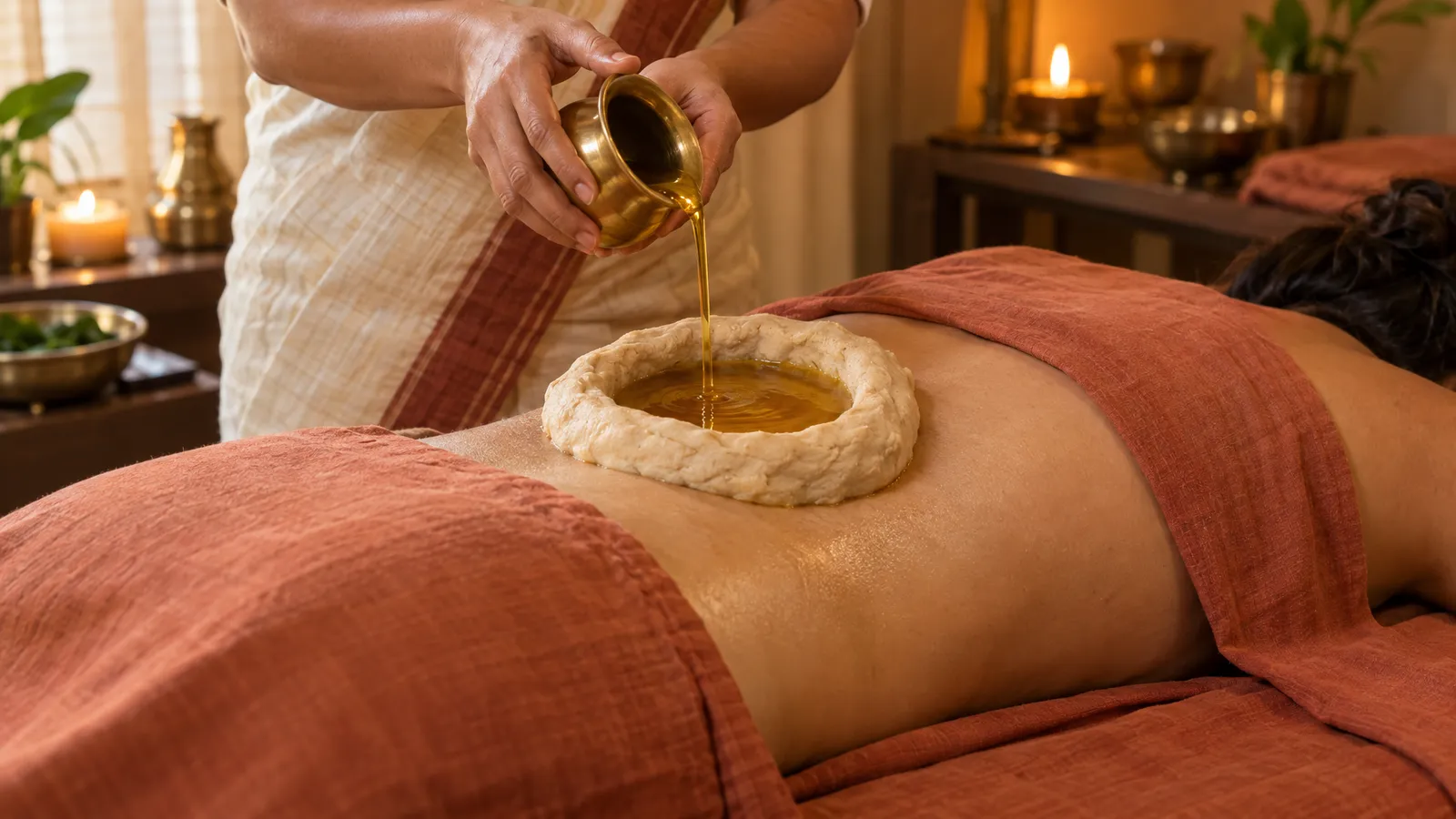
Kati Vasti (also spelled Kati Basti) is an Ayurvedic treatment for the lower back in which warm herbal oil is pooled over the lumbar area inside a ring of dough. In a 2024 clinical trial of the treatment, the dough was made from black gram powder and water, and the oil was kept warm over a water bath so its temperature stayed steady while it sat on the back.
The authors of that trial describe Kati Basti in Ayurvedic terms as "a kind of Snigdha Sveda," which they gloss as oil application and heat therapy given together (Bhatta et al., 2024). That is the easiest way to picture it: warmth and oil held in one place, rather than hands working the muscles.
Unlike a massage, the pooling part of Kati Vasti involves no kneading or deep pressure. You lie still while the oil stays in place. Think of it less like a massage and more like a warm compress over the lower back, except that the warmth comes from oil held inside the dough ring.
How Kati Vasti Works: Step by Step
Details vary by practitioner. This is how the procedure was described in the 2024 trial, which is one published account rather than a standard every studio follows:
1. Dough ring. You lie face-down. A thick dough of black gram powder and water is shaped into a ring and pressed onto the lower back to form a well.
2. Oil pooling. Warm herbal oil is poured into the well. In the trial, the oil was heated over a water bath to keep a steady temperature, and patients lay with the oil-filled dough in place for 30 to 45 minutes.
3. Removal. The oil and dough are then removed. At Shanti Dhara, Kati Vasti is booked together with an Abhyanga warm-oil massage, so the session also includes that massage.
In the trial, participants had Kati Basti daily for one week as part of a residential program. That was a research schedule, not a recommendation, and it is not how Shanti Dhara's menu sells the treatment.
What the Research Shows
The clearest recent study is a randomized controlled trial published in the Journal of Ayurveda and Integrative Medicine in 2024 (Bhatta et al.). Forty people with chronic low back pain at a health center in South India were split into two groups of 20: one had a one-week residential yoga program alone, the other had the same yoga program plus Kati Basti.
Of the 40, 37 were assessed at three months (18 in the yoga-plus-Kati-Basti group, 19 in the yoga-only group). Within each group, pain and disability scores fell significantly at one week and at three months. Depression scores (Beck Depression Inventory) fell significantly in both groups at one week; at three months the drop was still significant in the yoga-only group but not in the yoga-plus-Kati-Basti group, according to the paper's results table, even though the abstract summarizes depression as improving in both groups at both time points. Across groups, the between-group analysis found "no significant interaction effect" for pain, disability, depression or quality of life, and the authors concluded that "Both interventions demonstrated comparable results in pain reduction and disability improvement." In other words, adding Kati Basti to yoga did not produce a measurably bigger drop in pain than yoga alone in this trial.
The authors list their own limitations: a small sample, a one-week intervention, and participants from both groups sharing accommodation, which makes it harder to separate the effects of each program. A single trial of 40 people cannot show that Kati Vasti treats back pain, and it cannot show that it doesn't; it simply doesn't establish a benefit beyond what yoga gave.
For context on massage more broadly, the US National Center for Complementary and Integrative Health reports a review that found "evidence that massage was helpful for chronic low-back pain but the strength of the evidence was low," and notes that the American College of Physicians left massage out of its 2017 recommendations for chronic low-back pain (NCCIH). None of that research tested Kati Vasti.
Who Might Choose Kati Vasti
Kati Vasti isn't a cure for any back problem. People who look for it are usually after one of these:
- A still, warm treatment for everyday lower back stiffness. If you sit most of the day and your lower back feels tight by evening, you may prefer warmth to pressure. Our guide to Ayurvedic massage for desk workers covers that routine.
- Something gentler than deep tissue work. The pooling part involves no pressure, which some people with sensitive backs prefer.
- A relaxing session. Lying still under steady warmth is restful for many people. That is a comfort benefit, not a medical one.
Check first if: you have back pain that radiates down a leg, numbness or weakness, a diagnosed disc or spine condition, or a recent injury. Kati Vasti won't treat a disc herniation or a compressed nerve; get a doctor's or physical therapist's assessment and clearance first, and mention the condition when you book. Don't book with open wounds, a rash or a skin infection on the lower back. If you're pregnant, check with your clinician and ask the studio whether the treatment suits you before booking.
Kati Vasti vs. Massage for Back Pain: What's the Difference?
People often wonder whether Kati Vasti is just a fancy version of a back massage. It isn't; the two feel quite different, as explored in our comparison of Kati Vasti vs. regular massage for back pain.
What happens: Massage works by pressing, kneading and stretching muscle and soft tissue. The pooling part of Kati Vasti relies on warm oil held in one place, with no kneading or deep pressure.
How it feels: Both can be relaxing. Massage is active and hands-on; Kati Vasti is still and quiet, closer to lying under a warm compress.
If you've just hurt your back: neither is a first step. The NHS advises that for the first couple of days after a sprain or strain you "try to avoid heat (such as hot baths and heat packs), alcohol and massages" to manage swelling, and to get urgent advice if the injury gets worse, swells a lot or doesn't improve (NHS). A new injury should be assessed before you book either warm oil or massage.
For ongoing stiffness: choose by what you'd like to feel. Massage if you want hands-on pressure; Kati Vasti if you'd like warmth over the lower back. At Shanti Dhara the two come together anyway: Kati Vasti is booked as part of an Abhyanga + Kati Vasti session.
The Oils: What's in the Pool?
Kati Vasti uses a medicated herbal oil rather than plain oil, and different practitioners and studies use different ones. In the 2024 trial the oil was Ksheerabala taila. An earlier conference abstract compared Kati Basti using two other oils, Sahacharadi taila and Maha Narayana taila, for sciatica (Ancient Science of Life, 2013). Formulations vary by maker, so the name on a bottle doesn't tell you its exact ingredient list.
You may also read about oils made with Nirgundi (Vitex negundo). A 2003 rat study in the Journal of Ethnopharmacology found anti-inflammatory and pain-reducing activity from an oral water extract of Nirgundi leaves (PubMed). That was an animal study of an extract taken by mouth; it doesn't tell you what an oil applied to the skin does in people.
At Shanti Dhara Wellness in Palo Alto, the menu describes the treatment as warm herbal oil pooled over the lumbar area; it doesn't name a specific formulation. If you have a known allergy to sesame, nuts or any herb, or sensitive skin, tell the studio when you book and ask which oil is used.
What to Expect During Your First Session
Before the session: A light meal beforehand is usually more comfortable than a heavy one if you'll be lying face-down. Wear clothes you don't mind getting a bit oily.
During the session: You'll lie face-down while the dough ring is placed and the warm oil poured in. The treatment is meant to feel gently warm. If the oil feels too hot or anything is uncomfortable, say so right away.
After the session: Ask the studio what aftercare it recommends, including when to shower off the oil.
How many sessions: The menu doesn't recommend a schedule, and the trial above used a one-week residential program that isn't comparable to occasional spa visits. If you're managing an injury or a diagnosed condition, follow your doctor's or physical therapist's plan.
Booking Kati Vasti at Shanti Dhara Wellness
Shanti Dhara offers Kati Vasti as part of an Abhyanga + Kati Vasti session: 75 minutes for $258 or 90 minutes for $298.
- Abhyanga + Kati Vasti (75 minutes, $258): the Abhyanga warm-oil massage plus Kati Vasti on the lower back.
- Abhyanga + Kati Vasti (90 minutes, $298): the same combination with more time.
To book, visit the Kati Vasti page and choose a session length, or call (650) 283-9121. If you have a recent injury or a medical condition affecting your spine, get your doctor's clearance and mention it when you book.
Shanti Dhara Wellness is at 2875 Middlefield Rd, Suite 8 (2nd floor), Palo Alto. Hours: Tuesday and Sunday 10:00 AM - 4:30 PM, Wednesday-Saturday 10:30 AM - 6:00 PM; closed Monday. If you're new to Ayurvedic bodywork, our guide on preparing for your first Ayurvedic treatment covers the basics.
FAQ: Kati Vasti for Back Pain
Does Kati Vasti hurt?
It's intended to feel gently warm, and the pooling part involves no deep pressure. It shouldn't hurt; if the oil feels too hot or anything is uncomfortable, tell the practitioner right away.
Does Kati Vasti work for chronic low back pain?
The evidence is thin. In a 2024 randomized trial of 40 people, adding Kati Basti to a one-week yoga program gave comparable improvements in pain and disability to yoga alone, with no significant difference between the groups. The authors noted the small sample and short program as limitations.
Can I do Kati Vasti if I have a herniated disc?
Kati Vasti won't treat a disc herniation. Get your doctor's or physical therapist's clearance before booking, and tell the studio about the herniation when you book.